
Ceramic Matrix Composites (CMC)
Temperature ceiling of aircraft engines
② Common Knowledge: What is CMC? Making Ceramics Shatterproof
Ceramics are heat-resistant and oxidation-resistant, making them ideal candidates for thermal protection and high-temperature structures. However, traditional ceramics have a fatal weakness:CrispyOrdinary ceramics undergo catastrophic failure when subjected to impact or thermal shock; once a crack initiates, it propagates rapidly. This "fail-fast" behavior limits their use in many engineering applications.
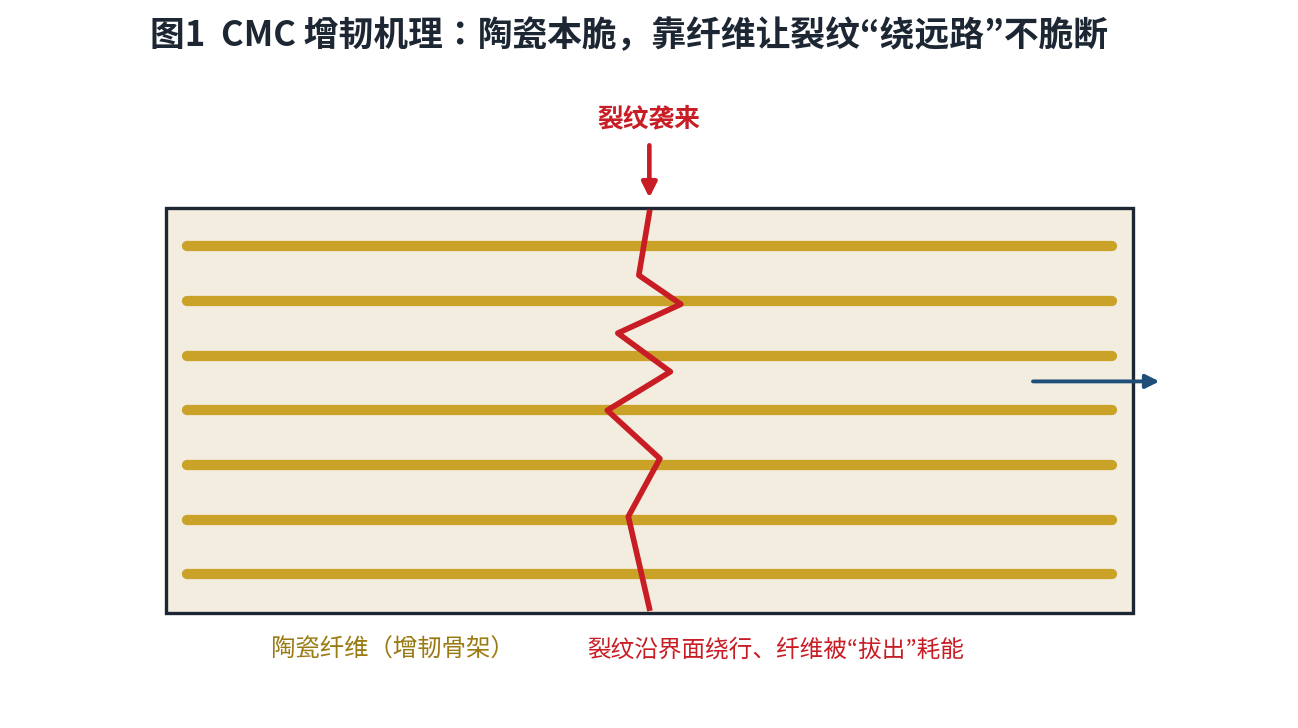
The advent of Ceramic Matrix Composites (CMC) was designed to solve this problem. Its core concept is:Embed continuous fibers in a ceramic matrixWhen a crack reaches the fibers, they don't fracture; instead, they pull out from the matrix, dissipating significant energy and halting further crack propagation. This is analogous to reinforced concrete: while concrete resists compression but is brittle, steel reinforcement withstands tension and provides ductility. Together, they create a structure that is both strong and tough.
Three major toughening mechanisms of CMC
- crack deflectionWhen a crack propagates through the matrix and encounters the fiber/matrix interface, it deflects along the interface rather than penetrating the fiber directly. This significantly increases the crack propagation path and energy dissipation.
- Fiber BridgingAfter the crack opens, fibers bridging the crack act like "bridges" to pull the two matrix sides together, generating a closing stress that inhibits further crack opening.
- Fiber pull-outWhen fibers finally fracture or debond, the "pull-out" process from the matrix requires work against friction. This is the primary mechanism by which CMCs absorb energy.
These three mechanisms work together to increase the fracture toughness of CMC by more than an order of magnitude compared to monolithic ceramics, enabling a transition from "brittle fracture" to "quasi-ductile failure."
③ Reality: CMC's "Core Roster"
Based on the combination of matrix and fiber, CMCs have established several mature systems:
C/SiC (carbon fiber-reinforced silicon carbide)
One of the most mature CMC systems. Carbon fibers deliver high strength and thermal conductivity, while the SiC matrix provides oxidation resistance. Service temperatures reach 1400~1650°C in oxidizing environments. Widely used for turbine blades, combustor liners, nose cones, and leading edges of aerospace vehicles. GE's LEAP engine high-pressure turbine blades use C/SiC materials.
SiC/SiC (silicon carbide fiber-reinforced silicon carbide)
The most widely watched CMC system in the aviation engine sector. SiC fibers exhibit superior oxidation resistance at high temperatures compared to carbon fibers, with an overall service temperature up to 1200~1400°C (in long-term oxygen-rich environments). Its density is only 1/3 that of superalloys. GE, Safran, and Rolls-Royce are all extensively adopting SiC/SiC components in their next-generation engines.
C/C (Carbon Fiber Reinforced Carbon)
The CMC system with the highest heat resistance withstands temperatures above 2000°C in inert atmospheres. Primarily used for solid rocket engine throat linings, nose cones, and brake discs. Its drawback is oxidation starting above 400°C in oxygen-rich environments, requiring protective anti-oxidation coatings.
Oxide/Oxide CMC
Composed of oxide fibers (such as alumina and mullite) within an oxide matrix. Key advantages include long-term durability in oxygen-rich environments without requiring coatings, with a temperature resistance of approximately 1000~1200°C. Ideal for applications demanding high oxidation stability at relatively lower temperatures, such as thermal barrier coatings on engine exhaust nozzles.
4. Challenge: Why hasn't CMC "taken over the world" yet?
The performance advantages of CMCs are undeniable, yet they have not fully replaced superalloys due to several persistent engineering challenges:
- Extremely high manufacturing costsManufacturing CMC typically involves complex processes such as chemical vapor infiltration (CVI), polymer impregnation and pyrolysis (PIP), or melt infiltration (MI). Production cycles can span weeks to months, and yield rates are highly sensitive to process fluctuations. A single CMC turbine blade may cost 5 to 10 times more than a high-temperature alloy blade of the same size.
- Process Consistency ChallengesThe braiding density of fiber preforms, uniformity of matrix deposition, and control of interlayer thickness—tiny deviations in any of these steps can affect final performance. Maintaining performance consistency during mass production remains one of the biggest barriers to commercialization.
- Environment Barrier Coating (EBC) DependencySiC-based CMCs experience SiO₂ volatilization in high-temperature steam environments, leading to surface degradation. Environmental barrier coatings (e.g., Yb₂Si₂O₇, BaSrAl₂Si₂O₈) are required to isolate moisture attack. Achieving thermal expansion matching and long-term stability between the EBC and CMC substrate is itself a distinct research topic.
- Difficult to connect and assembleCMC cannot be welded like metals, and mechanical connections create stress concentrations at hole edges. Reliably joining CMC components to metal structures remains a key challenge in system integration.
- Design methodology is not yet mature.CMC failure modes differ fundamentally from traditional metals (progressive damage rather than yielding), rendering existing metal-based design codes and certification frameworks partially inapplicable. Establishing CMC-specific design, testing, and certification standards requires continued industry-wide collaboration.
⑤ Tianyi Perspective: CMC Is the Key to Unlocking Temperature Limits
Tianyi Quan'an regards CMC asCore Material Routes to Break the Temperature Ceiling of Aero Engines。
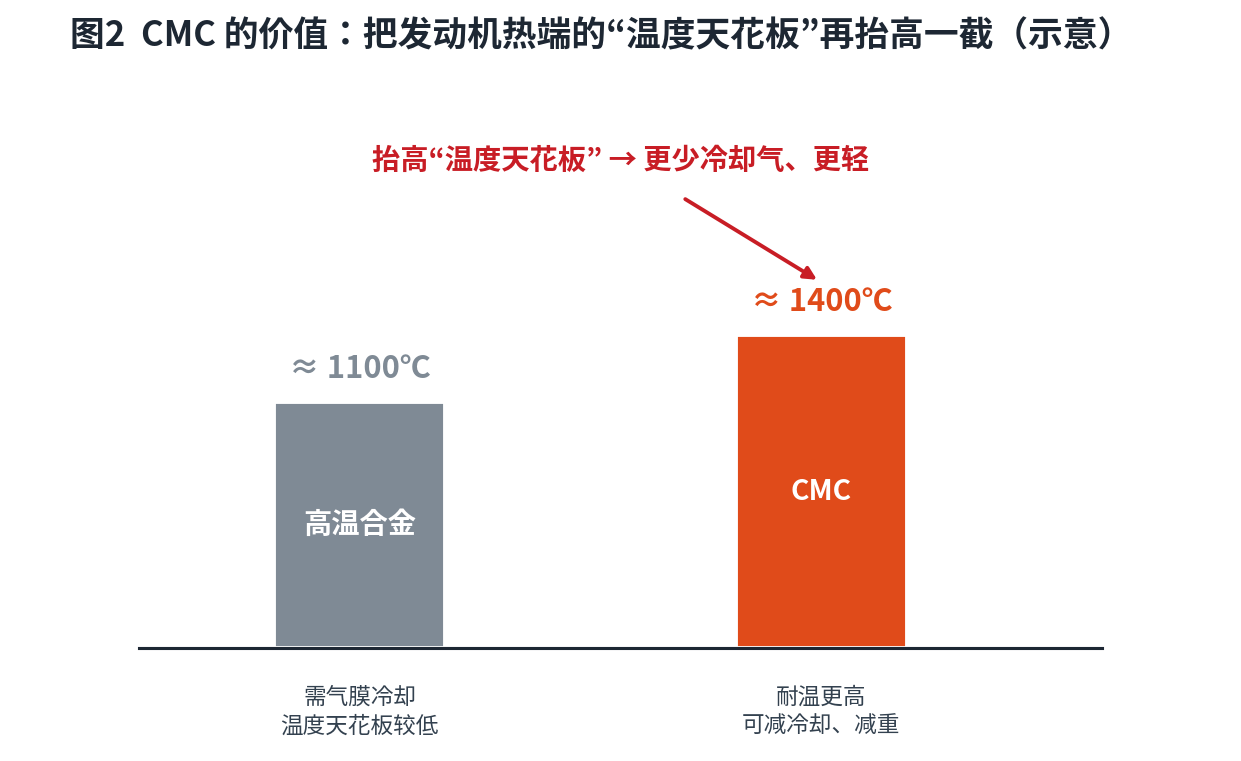
Today's most advanced single-crystal superalloy turbine blades rely on complex internal cooling channels and thermal barrier coatings (TBCs) to barely keep the metal surface temperature around 1100°C. In contrast, CMCs can operate with little or no cooling at 1200~1400°C, meaning:
- Higher turbine inlet temperature→ Higher thermal efficiency → Lower fuel consumption and emissions;
- Reduce cooling air usage→ More air for work → Increased thrust;
- Lose 30%~50%→ Reduce centrifugal load → Extend service life or enable higher rotational speeds.
In Tianyi Quan'an's material system, CMC is part of our exploration.Precursor-derived Ceramic (PHEC) CoatingThey form a complementary relationship: CMCs provide structural load-bearing and high-temperature resistance, while the PHEC coating serves as a surface protection layer that offers oxidation resistance, erosion resistance, and an environmental barrier. Together, they enable long-term operation of CMC components in extreme environments without relying on costly EBC systems.
We believe CMC is not a "one-size-fits-all" material, but ratherAchieve what metals can't in the right temperature range.A key role. At Tianyi Quan'an, our goal in this sector is to position CMC correctly, use it effectively, and make it affordable.
⑥ Further Reading · Test Consultation
In-site Extensions:
- → Material Map: Comprehensive Overview of Thermal Protection Materials
- → Ablative materialsA classical survival strategy: sacrifice yourself.
- → Ceramic Fiber and Nano-Insulation Blanket: Cage the air
- → aerogel: The World's Lightest Solid: Why It Didn't Dominate the Market
Consultation Test
Not sure if your application suits a CMC solution? Contact Tianyi Extreme Environment Lab to evaluate your thermal conditions and get matched CMC materials and protection system designs.