
aerogel
The Lightest Solid on Earth: Why It Didn't Conquer the World
② Common Knowledge: What is Aerogel? — Remove the liquid, leaving behind the skeleton.
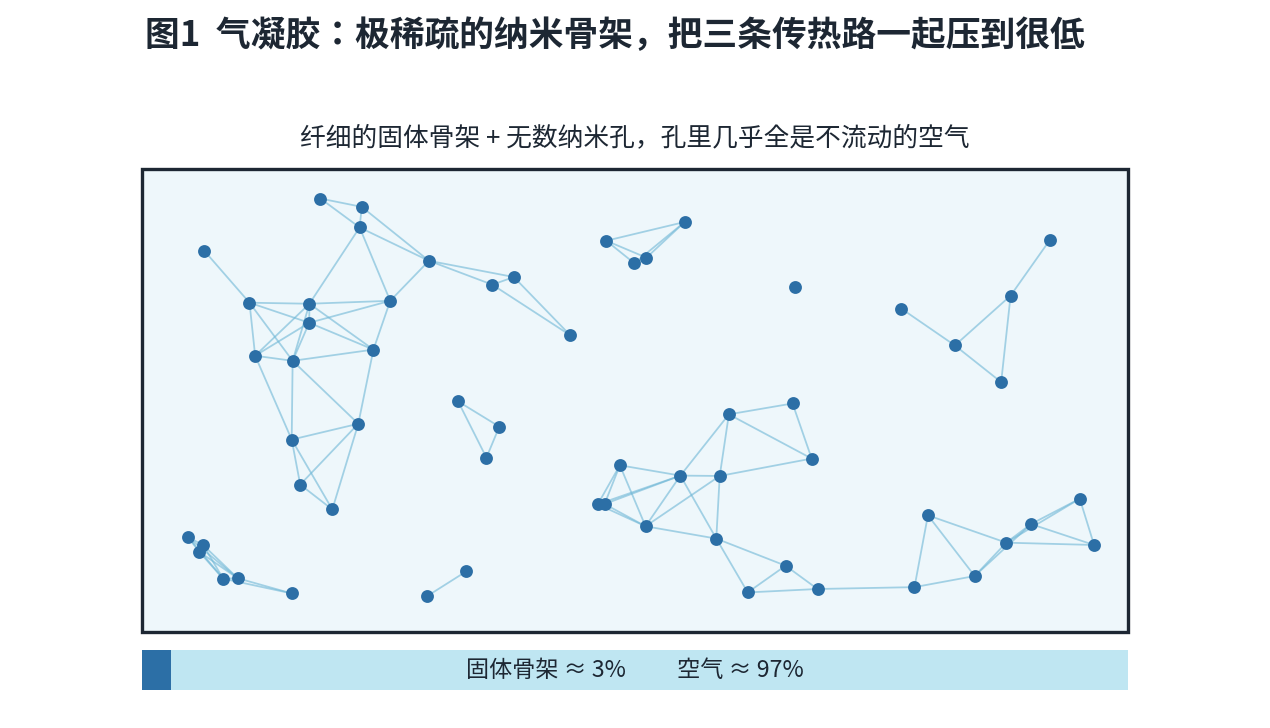
Aerogel: Despite the "gas" in its name, it is not a gas but aSolid-state materialsIts unique feature is that more than 99% of its volume is air, with the solid skeleton accounting for less than 1%. In other words, holding an aerogel in your hand is almost like holding a clump of "frozen air."
The preparation of aerogel can be simplified into three steps: first, create a wet gel (similar to jelly); then, replace the liquid inside with gas using supercritical or ambient pressure drying while preventing the skeleton from collapsing. The final product retains the gel's nanoporous network structure but is extremely lightweight and offers exceptional thermal insulation.
Why is aerogel insulation so effective?
Heat transfer occurs through three pathways:Conduction, Convection, Radiation. Aerogel is called a "super insulator" because it blocks all three heat transfer paths:
- Suppress gas conductionThe pore diameter is between 10 and 50 nanometers, smaller than the mean free path of air molecules (approximately 70 nm). Air molecules bounce back before reaching the opposite wall, almost completely suppressing gas conduction—this is the Knudsen Effect.
- Suppress solid-phase conduction: The solid skeleton is extremely slender, and the heat transfer path is long and narrow, resulting in very low efficiency of heat conduction along the skeleton.
- suppress radiative heat transferNanoscale pores strongly scatter infrared radiation, significantly reducing radiative heat transfer at high temperatures.
The combination of these three factors reduces the thermal conductivity of SiO₂ aerogel to as low as0.015~0.022 W/(m·K)lower than still air (0.026 W/(m·K)), making it one of the solid materials with the lowest known thermal conductivity.
③ Reality: The "Main Force" of Aerogel
Aerogels are not limited to a single type. Based on chemical composition, they fall into multiple categories, each suited for specific applications:
SiO₂ aerogel
The most mature and widely used aerogel type. It has the lowest thermal conductivity (0.015~0.022 W/(m·K)) and can withstand temperatures up to approximately 650°C over long periods. Commonly used for building insulation, pipe lagging, and spacecraft thermal protection. Its main drawbacks are high brittleness and low mechanical strength, so it is typically composite with fiber mats.
Carbon Aerogel
Carbon-based skeleton; withstands temperatures above 2000°C in inert atmospheres with excellent conductivity. Ideal for high-temperature insulation, electromagnetic shielding, and electrode materials. Note: it oxidizes and degrades in oxygen-rich environments, requiring protective measures.
Organic Aerogel
Materials such as phenolic and polyimide aerogels offer superior flexibility compared to inorganic aerogels and can be formed into elastomers. They typically withstand temperatures from 200 to 300°C, making them ideal for emerging applications like wearable devices and flexible electronics.
Composite Aerogel Thermal Protection Material
Embedding ceramic fibers as a reinforcement skeleton within an aerogel matrix, followed by applying functional coatings such as SiC, creates a material that combines nanoscale insulation, fiber-level toughness, and coating-grade protection. This represents the critical form factor for transitioning aerogels from laboratory research to engineering applications. Tianyi Quan'an's Yuanxian series exemplifies this technology, offering long-term temperature resistance above 1200°C and reusability of at least 50 cycles.
④ Challenge: Strong strengths, but also clear weaknesses
While aerogel offers exceptional insulation, it has not yet dominated the market. Several inherent limitations restrict its direct application in many scenarios:
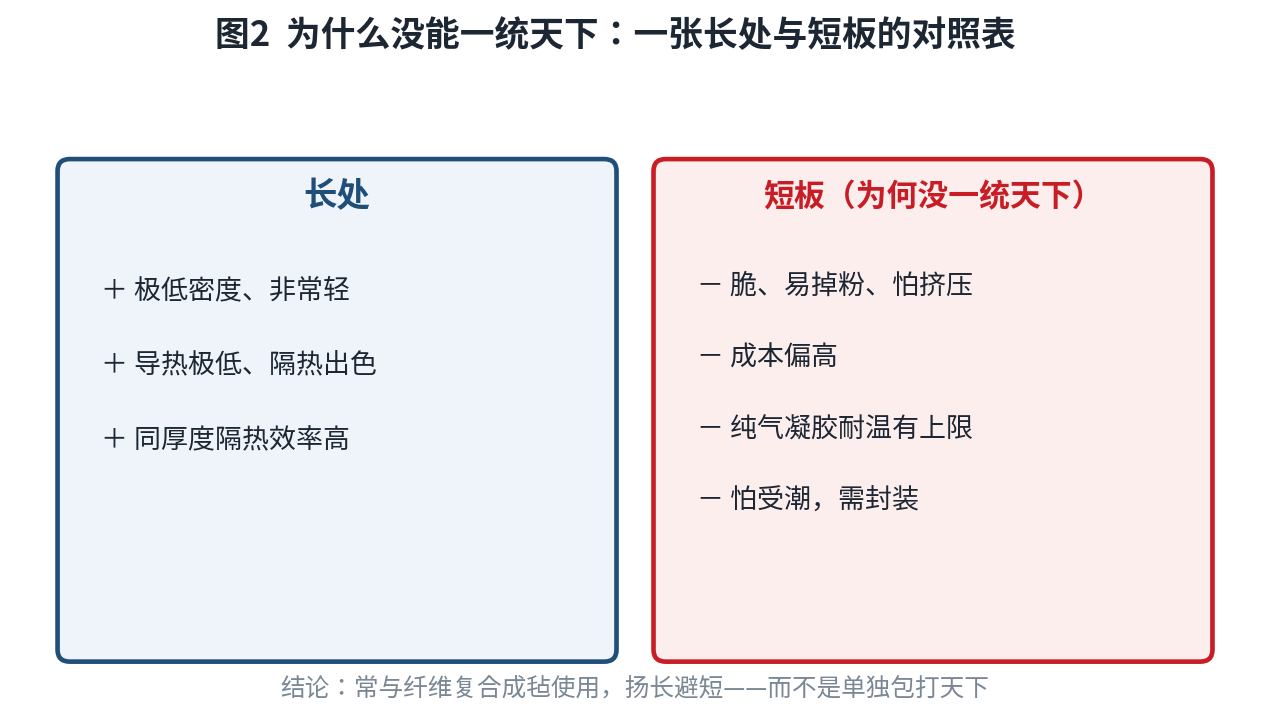
- Brittle and low mechanical strengthPure SiO₂ aerogel resembles "solid smoke"—it crumbles at the slightest touch. It cannot withstand any load or airflow erosion on its own and must be composite with fibers, coatings, etc., for engineering applications.
- Limited maximum operating temperatureThe long-term operating temperature of SiO₂ aerogel is approximately 650°C. Exceeding this limit causes the skeleton to sinter and shrink, leading to a sharp decline in insulation performance. For conditions above 1000°C, alternative materials or composite treatments are required.
- High costSupercritical drying is energy-intensive and time-consuming, making aerogels significantly more expensive than traditional ceramic fiber blankets. Although atmospheric pressure drying helps reduce costs, it still struggles to compete on price with conventional materials.
- HygroscopicAerogel that has not been hydrophobized readily absorbs water, causing a significant drop in thermal insulation performance. In engineering applications, waterproofing or hermetic sealing is required.
- Scaling Production ChallengesMass production of large-area, uniformly thick aerogel panels remains challenging; achieving high yield and consistency is an ongoing engineering challenge.
It is precisely these limitations that mean aerogel is not a "universal insulation material," but ratherMaximize your strengths in the right place.Materials. In engineering, the solution is often a "layered composite": an outer layer made of heat-resistant, erosion-proof materials to withstand harsh conditions, while an inner layer uses aerogel to block heat. Each layer performs its specific function.
5. Tianyi Perspective: From "Single Aerogel" to "Composite Aerogel Thermal Protection System"
Tianyi Quan'an's stance on aerogel is:Acknowledge its thermal limits, but prioritize making it functional, user-friendly, and durable.。
Our Yuanxian series (composite aerogel thermal protection felt) is the engineering realization of this concept:
- Core Insulation Layer: Aerogel matrix thermal conductivity 0.018~0.025 W/(m·K) delivers near-theoretical-limit insulation performance.
- Enhance SkeletonThe ceramic fiber network provides sufficient mechanical strength and resistance to gas erosion, solving the fragility issue of pure aerogel.
- Surface ProtectionThe SiC coating provides oxidation and erosion resistance, raising the maximum operating temperature to >1200°C and enabling ≥50 reuse cycles.
More importantly, we don't sell aerogel as an isolated material; instead, we integrate it into..."Heat Flow vs. Time" System DesignTailor the aerogel layer's thickness, placement, and protection strategy based on specific operating conditions—heat flux magnitude, duration, and reuse requirements—to maximize its value within the overall thermal protection system.
We believe the future of aerogel lies not in "replacing everything," but inDo what other materials can't, in the right place and the right way.This journey from the lab to real-world engineering is exactly where Tianyi Quan'an is headed.
⑥ Further Reading · Test Consultation
In-site Extensions:
- → Material Map: Comprehensive Overview of Thermal Protection Materials
- → Ceramic Fiber and Nano-Insulation Blanket: Cage the air
- → Insulation ≠ Heat Resistance ≠ Heat ProtectionThree commonly confused terms
- → Three Hot PathsConduction, Convection, Radiation: The Three Lines of Defense Against Heat
Consultation Test
Not sure if your operating conditions suit an aerogel solution? Contact Tianyi Extreme Environment Lab to evaluate your thermal environment and get recommendations for matching insulation materials and system designs.