
Ceramic Fiber and Nano-Insulation Blanket
Enclose air in a cage
② Common Sense: The Essence of Insulation — Trapping Air in a Cage
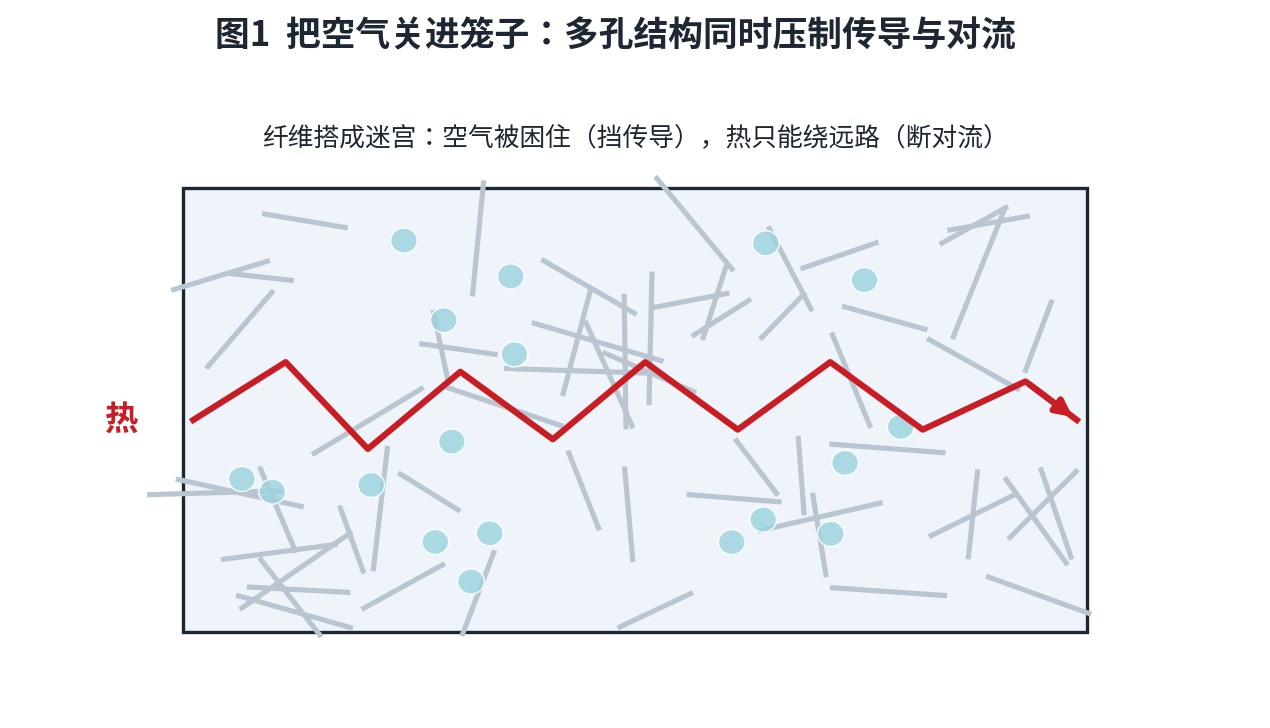
All insulation materials ultimately do the same thing:Trap insulating air in countless tiny cellsAir itself is an excellent insulator, with a thermal conductivity of only 0.026 W/(m·K)—far lower than most solids. The challenge is that when air moves, it carries heat away via convection. Therefore, effective insulation isn't about eliminating air; it's about trapping it in tiny spaces where it can't circulate.
Ceramic fiber and nano-insulating aerogel blanket exemplify this approach: the former creates a maze with micron-sized fibers, while the latter "freezes" air in place using nanopores.
③ Reality: Ceramic fiber creates a "thermal maze" using micrometer-scale fibers.
Ceramic fibers (such as alumina, mullite, and zirconia fibers) are the primary choice for high-temperature insulation. With diameters typically ranging from 2 to 10 micrometers, they are randomly layered into blankets or boards. This structure creates numerous micron-scale pores that trap air, effectively suppressing convection.
The advantages of ceramic fiber includeHigh temperature resistance, low cost, mature processStandard aluminum silicate fiber can withstand temperatures of 1000~1260°C over the long term, high-purity alumina fiber up to 1400~1600°C, and zirconia fiber even up to 1800°C. They are widely used in industrial kiln linings, spacecraft thermal insulation, and high-temperature pipe insulation.
However, ceramic fiber also has significant drawbacks:
- Thermal conductivity increases with rising temperature.: At elevated temperatures, radiative heat transfer between fibers becomes dominant, with thermal conductivity rising from approximately 0.05 W/(m·K) at ambient temperature to 0.2~0.3 W/(m·K) at 1000°C.
- Weak resistance to air scouringThe loose fibrous structure is prone to erosion and flaking under high-speed airflow, requiring an additional protective facing layer.
- High-temperature shrinkage and crystallizationOver extended use, amorphous fibers may undergo crystallization and sintering, leading to volume shrinkage and degraded thermal insulation performance.
4. Advanced: Aerogel Insulation – When Pores Are So Small That Air Can't Move
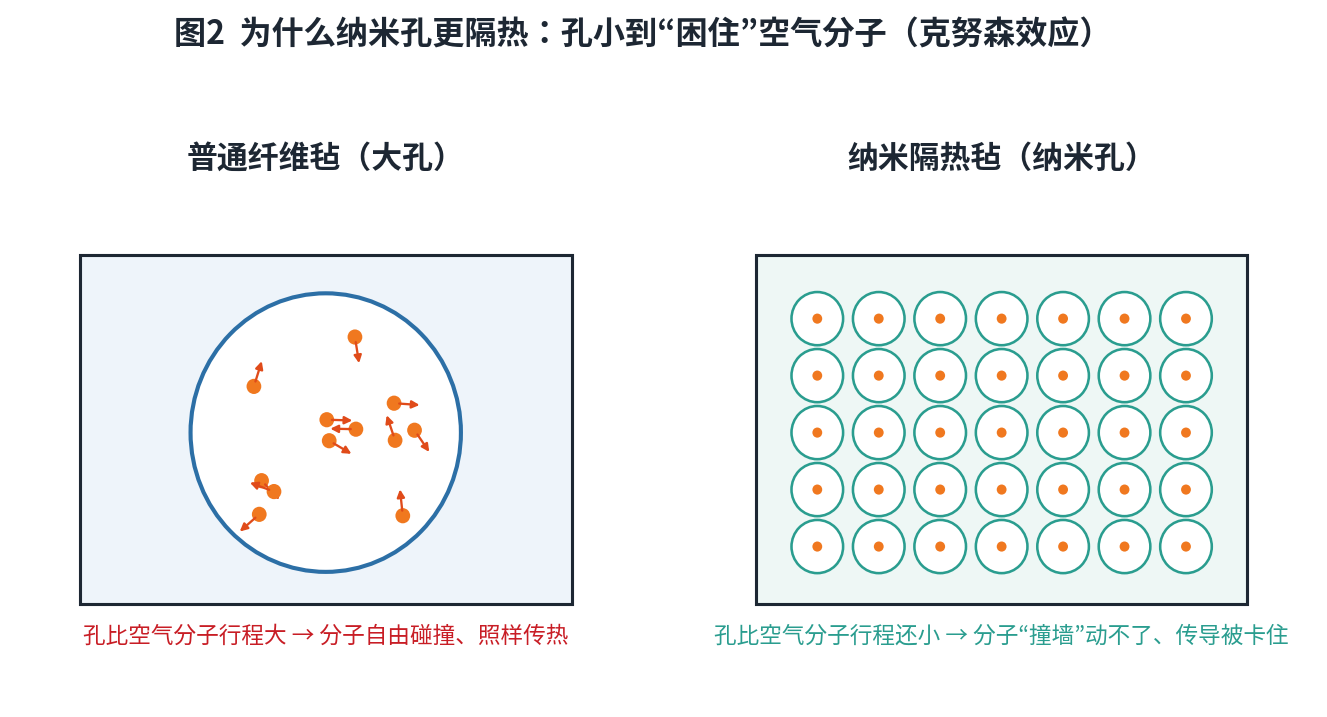
If ceramic fiber is like "micron-sized cages" trapping air, then nano-insulation felt shrinks those cages to the nanoscale.nanometer-levelNanoporous materials, represented by aerogels, typically have pore sizes between 10 and 50 nanometers—a scale smaller than the mean free path of air molecules (approximately 70 nanometers).
What does this mean? In such tiny pores, air molecules bounce back before they even reach the opposite wall.Gas conduction is almost completely suppressed.This is the famous "Knudsen Effect." Additionally, the solid-phase conduction paths within the nano-skeleton are extremely thin, and radiative heat transfer is attenuated by scattering from the nanostructure. The combination of these three factors enables aerogel-type materials to achieve thermal conductivities as low as0.015~0.025 W/(m·K), lower than still air.
Typical examples of nano-insulation blankets include:
- SiO₂ Aerogel BlanketLowest thermal conductivity (0.015–0.022 W/(m·K)), long-term temperature resistance up to 650°C, ideal for efficient insulation in low-to-mid-temperature applications.
- Composite Aerogel Thermal Protection BlanketEnhanced with ceramic fiber reinforcement and a surface SiC coating, this aerogel-based solution withstands temperatures above 1200°C and resists airflow erosion. Tianyi Quan'an's Yuanxian series is an example of this technology.
- Nano-porous insulation board: Compressed from nano-silica powder; withstands temperatures up to 1000~1200°C with structural integrity.
⑤ Challenge: There is no silver bullet; only a combination works.
Ceramic fiber and nano-insulation felt each have their strengths and weaknesses; in practice, they are rarely used alone.
- ceramic fiberHigh-temperature resistance and low cost, but high radiative heat transfer and weak erosion resistance at elevated temperatures;
- Nano-insulation blanketOffers ultimate thermal insulation, but pure aerogel is brittle, has limited temperature resistance, and carries a high cost.
The engineering solution isLayered GroupingThe outer layer uses high-temperature-resistant, erosion-proof materials (such as ceramic fiber boards or coatings) to face the heat directly, while the inner layer employs nano-insulation felt to block thermal transfer. This "tough outside, soft inside" design maximizes overall temperature resistance and pushes insulation performance to near-limit levels.
A more cutting-edge direction isComposite Aerogel Thermal Protection Material——Embedding ceramic fibers as a reinforcement skeleton within an aerogel matrix, then applying functional surface coatings such as SiC. This creates a single material that combines nanoscale thermal insulation, fiber-level toughness, and coating-grade protection—the ultimate engineering realization of "trapping air in a cage."
6. Tianyi Perspective: From "Controlling Airflow" to "Systematic Insulation"
Tianyi Quan'an's portfolio in thermal insulation materials spans the full spectrum from ceramic fibers to composite aerogels. Our Yuanxian series (composite aerogel thermal protection blankets and ceramic spiral fibers) is the engineering realization of the principle "trapping air in a cage":
- Composite Aerogel Thermal Protection BlanketCore insulation layer thermal conductivity: 0.018~0.025 W/(m·K). Surface SiC coating provides erosion and oxidation resistance, with long-term temperature tolerance >1200°C and reusability ≥50 times.
- ceramic spiral fiber: Zirconia, alumina, and other systems feature thermal conductivity of 0.055~0.100 W/(m·K), long-term temperature resistance up to 200~1800°C, stable insulation performance, and high retention of structural strength at elevated temperatures.
But what we value more isSystematizedThe thermal insulation layer does not operate in isolation; it must work in concert with the outer high-temperature/erosion-resistant coating and the surface radiative control layer. Tianyi Quan'an's approach treats the insulation material and precursor ceramic coating as an integrated system for design and validation. We evaluate the entire system's performance using "heat flux vs. time" curves, rather than relying solely on the thermal conductivity of individual materials.
We believe great insulation isn't about perfecting a single material—it's about using the right materials in the right places and integrating them into a system proven to withstand rigorous testing.
⑦ Further Reading · Test Consultation
In-site Extensions:
- → Material Map: Comprehensive Overview of Thermal Protection Materials
- → Insulation ≠ Heat Resistance ≠ Heat ProtectionThree commonly confused terms
- → Three Hot PathsConduction, Convection, Radiation: The Three Lines of Defense Against Heat
- → Ablative materialsA classical survival strategy: sacrifice yourself.
Consultation Test
Not sure whether to use ceramic fiber or nano-insulation blanket for your application? Contact Tianyi Extreme Environment Lab. We'll assess your thermal conditions and recommend the best insulation solution.