
Ablative materials

Classical survival strategy: sacrifice oneself
② Common Knowledge: What is Ablation? — Actively "Disappearing" to Carry Away Heat
The term "ablation" derives from the Latin word *ablatio*, meaning "to carry away" or "removal." In the field of thermal protection, it refers to a unique strategy: rather than withstanding high temperatures through sheer resistance, the materialSacrifice your surface layer.By undergoing phase changes such as decomposition, gasification, and melting, it absorbs large amounts of heat as latent heat, thereby protecting the underlying structure from being burned through.
The principle is straightforward. Firefighters extinguish fires with water: as it evaporates, it absorbs massive heat, putting out the flames. Similarly, humans cool down by sweating—evaporation draws heat away from the skin. Ablative materials do the same thing, except they "evaporate" themselves. By sacrificing their own integrity, they protect the structure behind them.
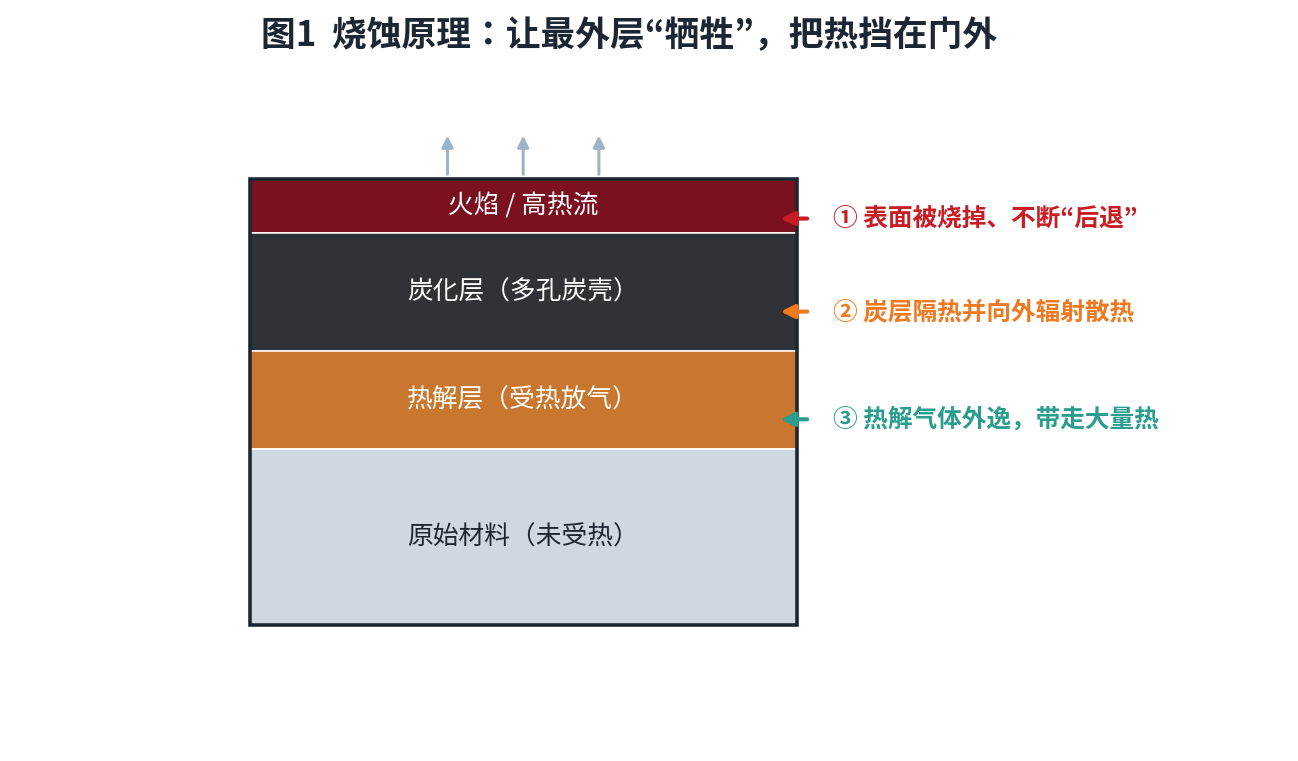
The Three "Heat-Sucking Moves" of Ablation
- Thermal desorptionOrganic resins (such as phenolic and epoxy) undergo pyrolysis at high temperatures, breaking chemical bonds that absorb significant energy while forming a porous carbon layer.
- Vaporization/Sublimation absorbs heat: Direct vaporization or sublimation on the material surface (e.g., carbon sublimating at extremely high temperatures), where the latent heat of phase change far exceeds the sensible heat required for simple temperature rise.
- Inject into the boundary layerGases from pyrolysis and gasification are injected into the high-temperature boundary layer on the vehicle surface, diluting the oxygen concentration in the freestream and reducing the convective heat transfer coefficient—effectively creating a "gas curtain" over the surface.
Combining these three mechanisms significantly enhances the actual thermal insulation performance of ablatives, far surpassing that of pure insulating materials of the same thickness. This is why ablation remains the only viable solution in scenarios involving extremely high heat flux over short durations.
3. Reality: The "Main Force" of Ablative Materials
After more than half a century of development, ablative materials have evolved into several mature categories, each suited to specific applications:
Phenolic resin-based composites
The classic ablative material. Phenolic resin produces high char yield with excellent residual char strength; when reinforced with glass or carbon fibers, it is widely used in rocket engine nozzles and the heat shield base of reentry capsules. It is essential to the thermal protection systems of both the Apollo and Shenzhou spacecraft.
Carbon/Carbon Composites (C/C)
Carbon fiber-reinforced carbon matrix withstands temperatures above 2000°C, making it the top choice for solid rocket motor throat linings and nose cones. However, it oxidizes in oxygen-rich environments and typically requires protective anti-oxidation coatings.
Silicone-modified epoxy ablation coating
Liquid ablative coating suitable for spray application, curing at room temperature with a simple process. Ideal for localized thermal protection of metal structural components, such as interstage sections and instrument bay exteriors of launch vehicles. Tianyi Quanan's Muyu series (SER-1A, PSER-8A) belongs to this category.
Ceramic-modified silicone rubber ablation coating
Adding ceramic fillers to a silicone rubber matrix balances flexibility with ablation resistance. Ideal for applications requiring elasticity and thermal shock resistance, such as thermal protection for sealing surfaces on moving spacecraft components.
4. Challenges: The Cost and Limitations of Ablation
While ablation is efficient, it is not a universal solution. Its "sacrificial" nature imposes several inherent limitations:
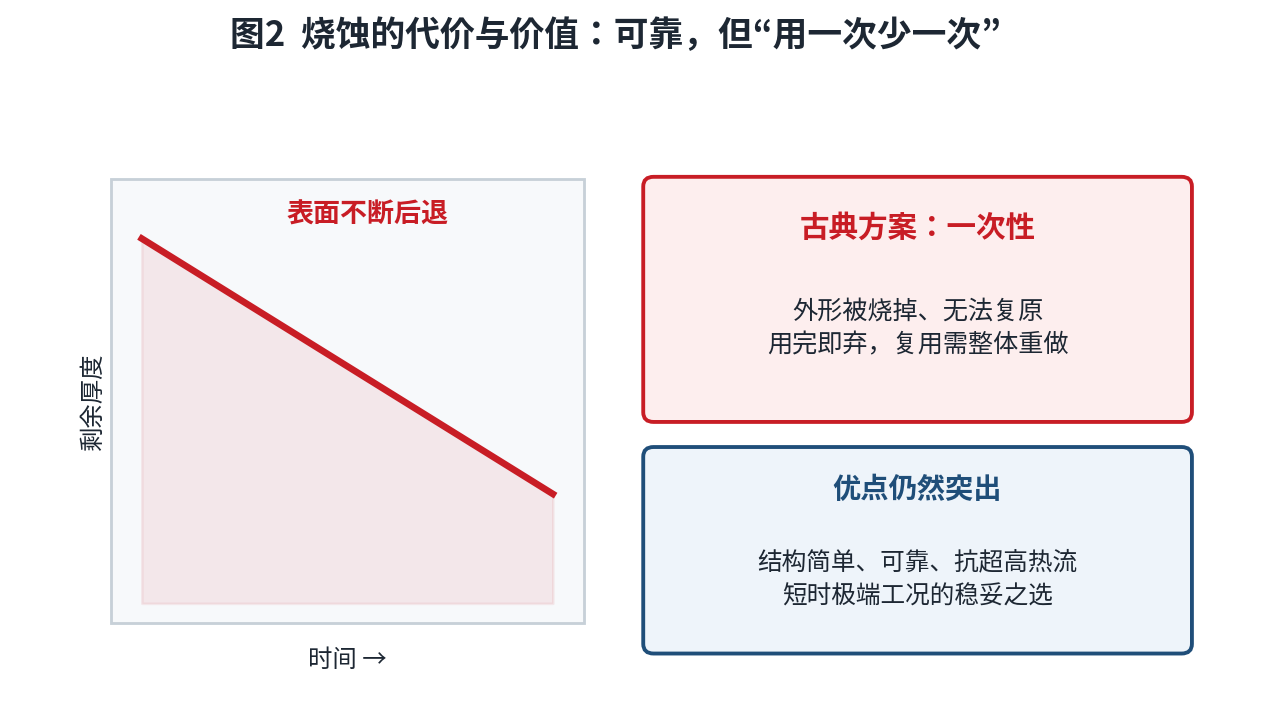
- Non-reusableAblative protection is single-use. The material is consumed during the mission and must be recoated or replaced for the next flight. For reusable vehicles, this means labor-intensive thermal protection system repairs after every recovery, significantly increasing costs and turnaround time.
- Quality ConsumptionAs ablation removes heat, it also erodes the material itself. Design must account for sufficient ablation margin, which increases launch weight. Higher heat flux and longer duration require thicker margins.
- Exterior changesDuring ablation, material is continuously consumed, altering the aerodynamic profile. For precision-guided vehicles, such shape changes can affect aerodynamic performance and flight stability, requiring early prediction and compensation in the design phase.
- Not suitable for long-term operationAblation is suitable for "short-duration, high heat flux" conditions (seconds to minutes). If the heat flux persists for tens of minutes or longer, the ablation layer will be fully consumed, requiring alternative mechanisms such as thermal insulation or radiative cooling.
These limitations have driven the development of non-ablative and micro-ablation approaches: Can we find a material that withstands extreme thermal environments without "sacrificing itself"? This is the cutting edge of current thermal protection research.
⑤ Tianyi Perspective: From "Ablative" to "Non-Ablative" – An Evolutionary Journey
Tianyi Quan'an's stance on ablative materials is:Honor its historical contributions, but do not be limited by them.。
Within our current product lineup, the Muyu series (SER-1A, PSER-8A) and Platinum Yu series ablation coatings (ZrSi-SR107-TA) leverage proven ablation technology to deliver reliable one-time protection for short-duration, ultra-high heat flux scenarios.
But our focus is on the next step: Can we make materials reusable without compromising their heat resistance? What we've exploredPrecursor Ceramic (PHEC)This route targets the new frontier of "ultra-high temperature + non-ablative + reusable." PHEC coatings withstand thermal shocks at 2200°C levels without significant ablation or material loss, maintaining their thickness. Theoretically, they support multiple reuses—a capability unattainable with traditional ablative materials.
We believe ablation is a proven, "classic" solution for thermal protection. Yet the future lies in shifting from materials that "sacrifice themselves" to those that "protect themselves." This evolution is exactly what Tianyi Quan'an is driving forward.
⑥ Further Reading · Test Consultation
In-site Extensions:
- → Material Map: Comprehensive Overview of Thermal Protection Materials
- → Insulation ≠ Heat Resistance ≠ Heat ProtectionThree commonly confused terms
- → Three Hot PathsConduction, Convection, Radiation: The Three Lines of Defense Against Heat
- → What does 1600°C mean?: From Home Ovens to Rocket Returns
Consultation Test
Unsure whether to choose an ablative or non-ablative solution for your application? Contact Tianyi Extreme Environment Lab to evaluate your thermal conditions and recommend the optimal material approach.