
The Reentry Blackout: Temperature, Time, and Distance from Humanity

During reentry, the spacecraft loses all contact with ground control for several minutes—this is known as "blackout." At this moment, the capsule is enveloped in gas heated to thousands of degrees, plunging into the atmosphere at near-meteor speeds. Temperature, duration, and the safety of those inside all depend on a thin layer of heat-shielding material.
During reentry, the spacecraft loses all contact with ground control for several minutes—this is known as "blackout." At this moment, the capsule is enveloped in gas heated to thousands of degrees, plunging into the atmosphere at near-meteor speeds. Temperature, duration, and the safety of those inside all depend on a thin layer of heat-shielding material.
Common Knowledge: The hottest, most dangerous, and most "disconnected" minutes
The capsule enters the atmosphere at high speed, compressing and heating the air ahead into a layer of hot ionized gas (plasma sheath) around it. This sheath causes peak heating and blocks radio signals, resulting in a communication blackout—known as blackouts.
Figure 1: The "Blackout Zone" during re-entry: the hottest, most dangerous, and most isolated few minutes.
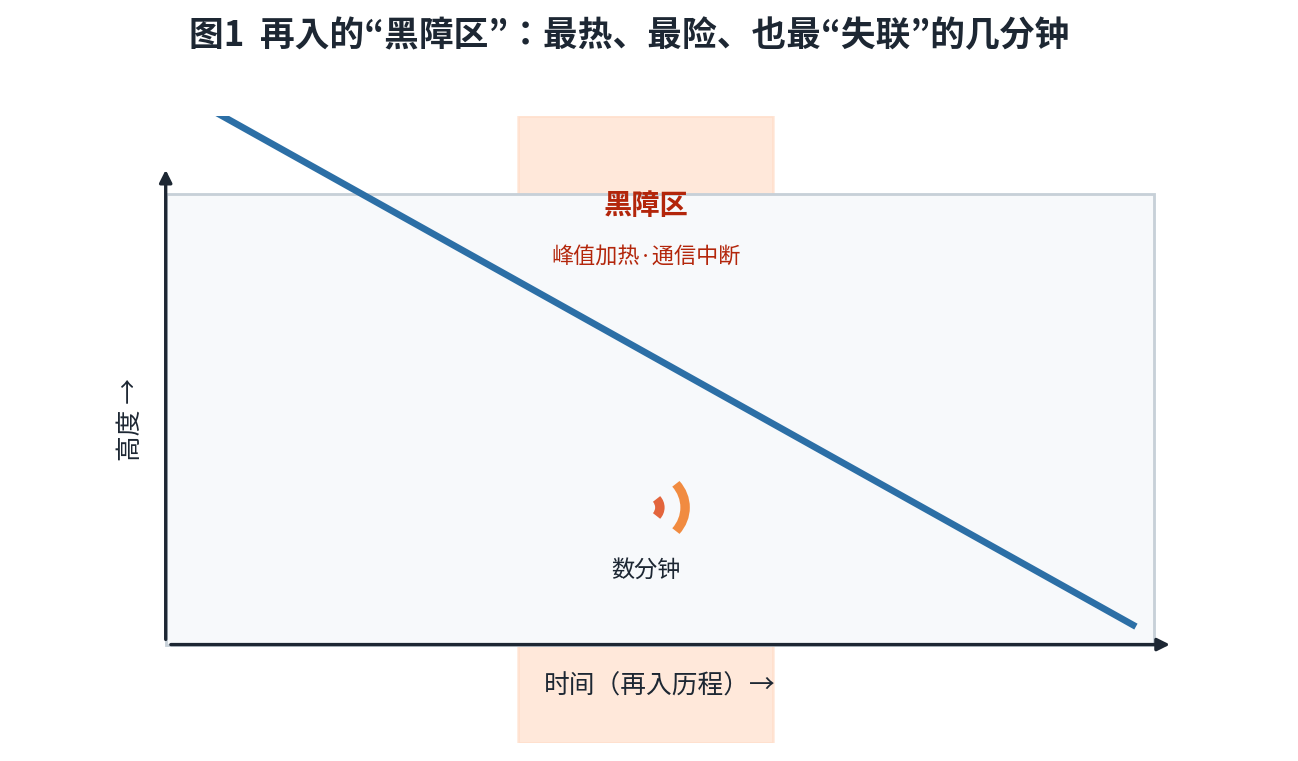
These few minutes concentrate the most intense heat flux of the entire reentry. The success or failure of thermal protection design hinges on this critical window.
Reality: A few centimeters apart, separating thousands of degrees from just tens.
Figure 2: A Layer of Separation: Just a few centimeters of heat shield stand between thousands of degrees and the people inside the cabin.
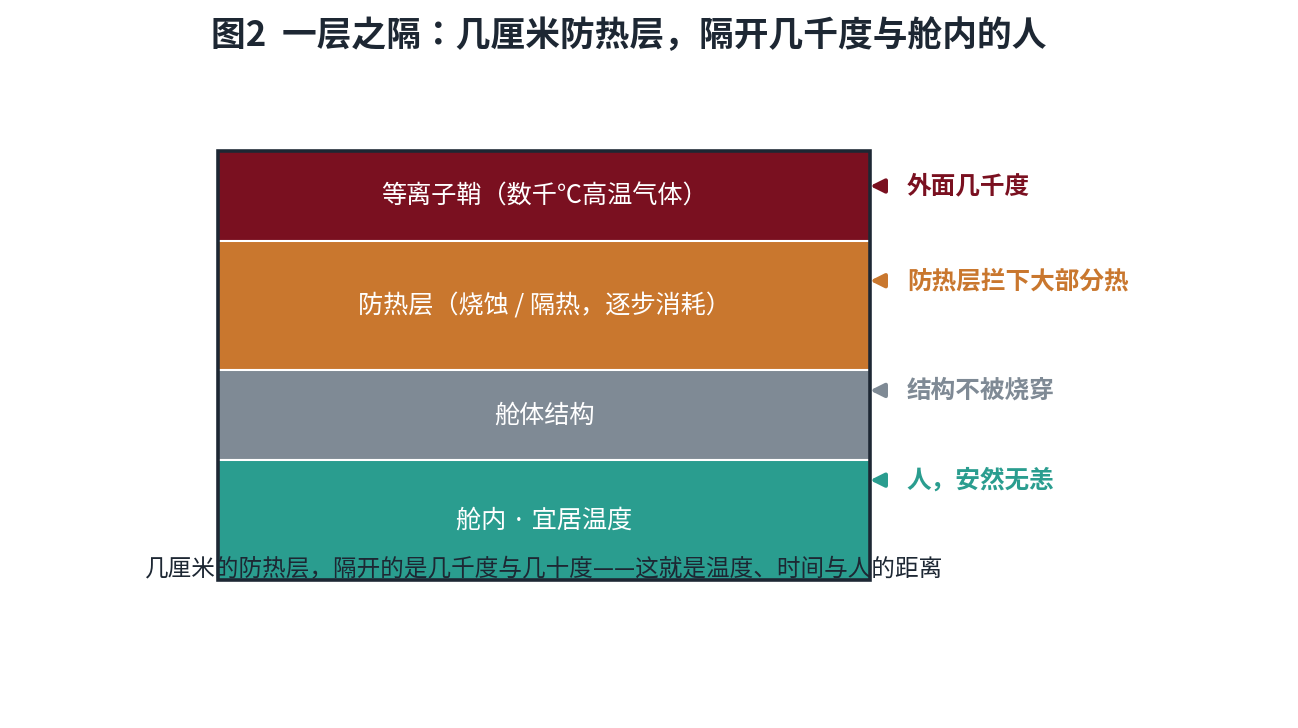
The exterior is enveloped by a plasma sheath at thousands of degrees, while the cabin interior must remain at a temperature humans can withstand. The critical link between these extremes is a few centimeters of heat shield material. Through ablation and insulation, this layer blocks and dissipates most of the heat, preventing structural failure and ensuring crew safety. In physical terms, the "distance" between extreme temperatures, time, and human survival is defined by the thickness of this protective barrier.
Challenge: Handle peak loads without adding unnecessary weight.
The heat shield must withstand extreme heat flux in an extremely short time without being too thick or heavy—every bit of weight reduces payload capacity. Even more challenging, slight variations in reentry trajectory, speed, and angle alter the intensity and distribution of heating; the material must provide sufficient margin without unnecessary excess.
Tianyi's Perspective: Recreating "Those Few Minutes" on the Ground
Flight tests during the blackout phase are impossible, but ground simulations can closely replicate these conditions. Tianyi Quan'an has established extreme environment testing capabilities, including arc jet wind tunnels, to bring the re-entry heat flux–time history into the lab. This allows thermal protection materials to be rigorously tested under peak heating conditions that closely mimic reality.
We believe true confidence comes not from a single successful flight, but from repeatable, measurable validations on the ground.