
Introduction to Aerodynamic Heating: Why Doubling Speed Octuples Heat Flux

The faster you fly, the more rapidly aerodynamic heating increases—not linearly, but with the cube of velocity. This curve dictates how challenging it is to engineer materials for high-speed flight. This article explains the wisdom of blunt bodies and why heat flux and time matter.
Nonlinear nature of aerodynamic heating
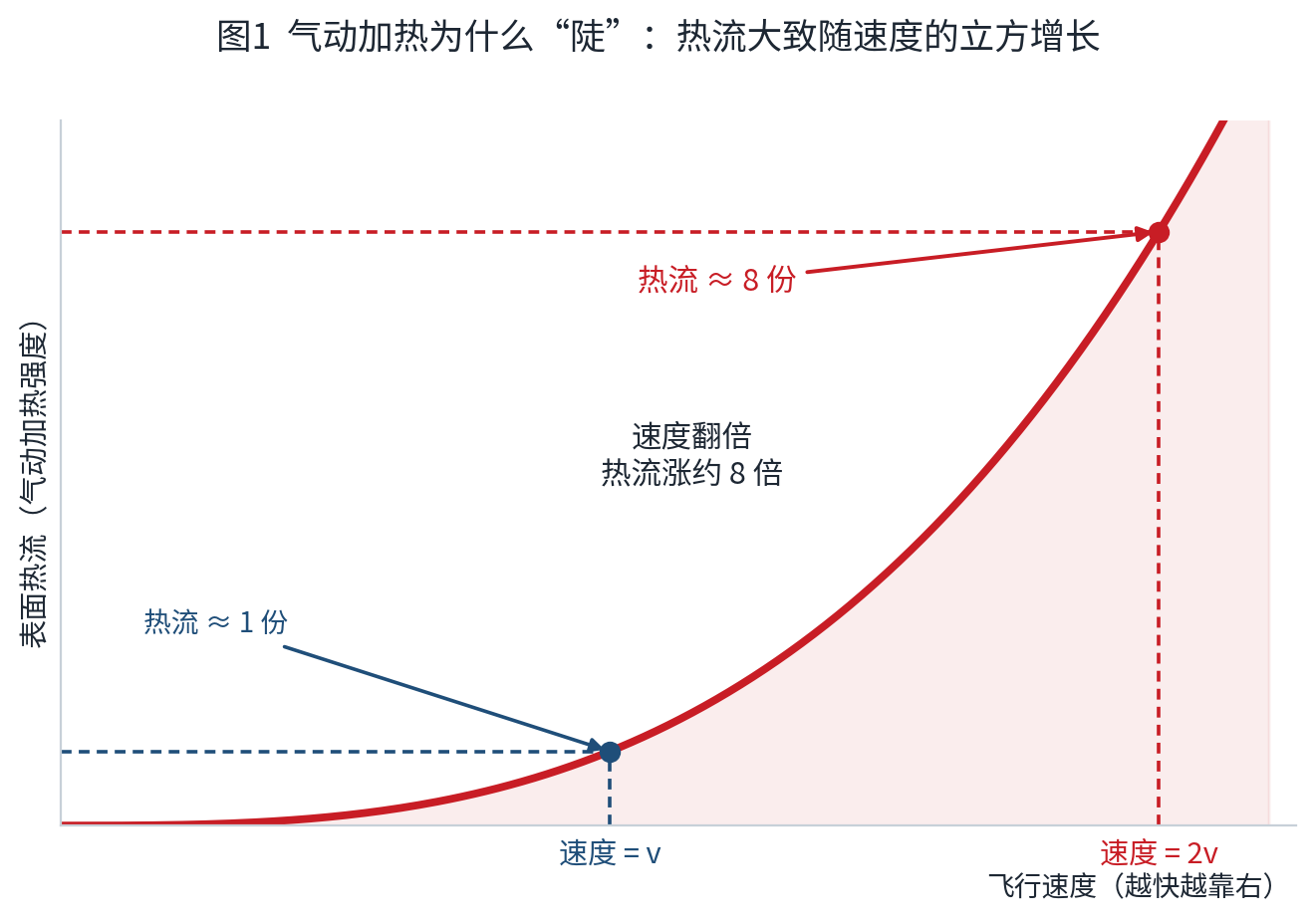
Aerodynamic heating arises from the heat generated by air compression and friction in front of a vehicle as it travels at high speed through the atmosphere. The key factor is that stagnation point heat flux scales with velocity.cubedis proportional to (q ∝ V³).
Consequences of doubling speed
When flight speed increases from 3 km/s to 6 km/s, heat flux does not double; it increases to {0} times the original.8xThis means that for each increment in Mach number, the difficulty of thermal protection increases exponentially. This is why thermal protection has evolved from a "secondary concern" at subsonic speeds to a "core bottleneck" at hypersonic speeds.
Wisdom of the Blunt
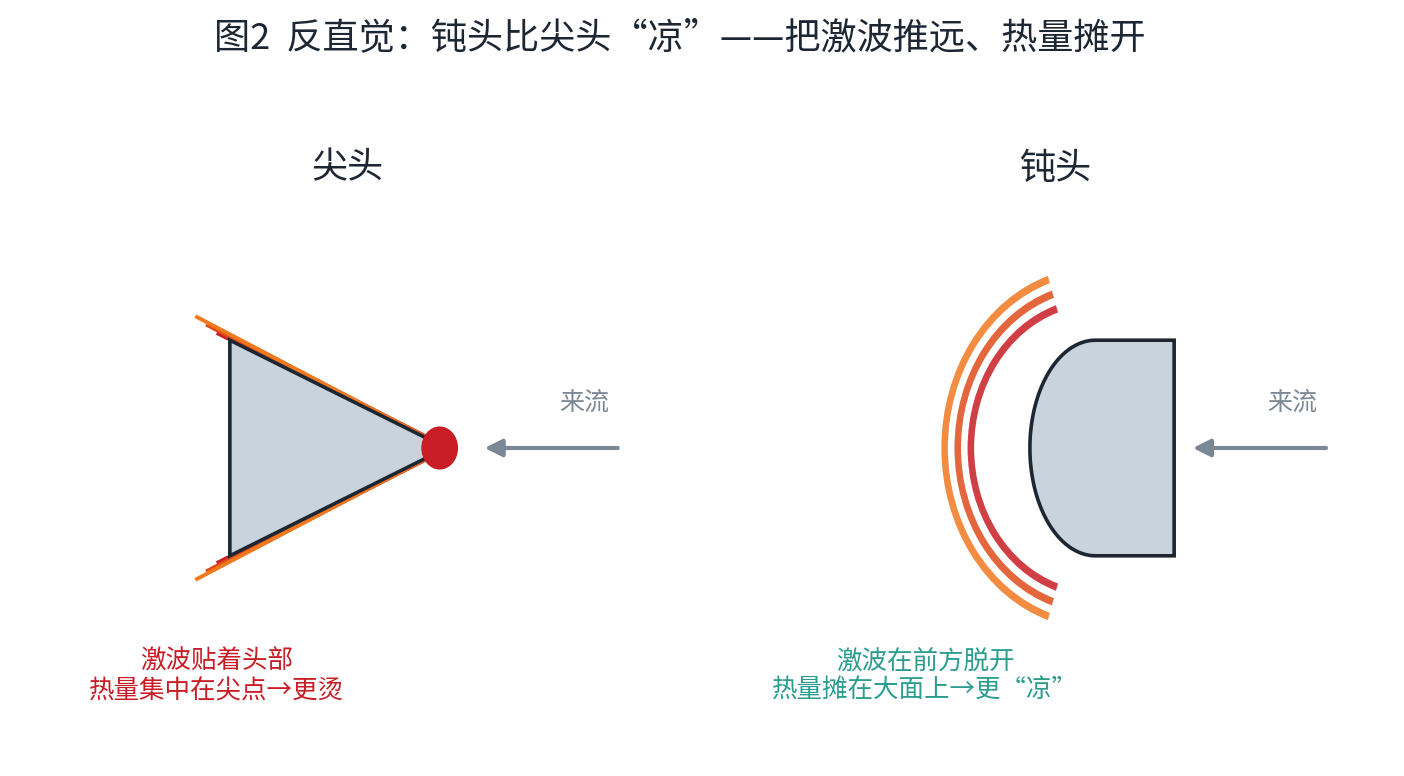
Intuitively, a sharp nose seems better for drag reduction. However, under hypersonic conditions, a blunt body is actually superior. This is because the detached shock wave in front of a blunt body is farther from the wall, allowing the hot gas behind the shock more space to expand and cool before reaching the surface. As a result, the heat flux at the wall is lower. Both the Apollo and Shenzhou spacecraft adopted this large-blunt-nose design based on this principle.
Heat Flux-Time Integral: Total Heat Input Is What Matters
While peak heat flux is important, the material usage is actually determined byTime integral of heat flux(i.e., total heat load). A scenario with a peak of 2 MW/m² lasting only 10 seconds may result in a lower total heat load than a scenario with a peak of 500kW/m² MW/m² lasting 300 seconds. Therefore, ballistic design (which determines the heating time history) and material selection must be optimized together; focusing solely on peak heat flux is insufficient.