
Thermal Barrier Coating (TBC)
The Value of 200 Microns on the Blade
② Common Knowledge: What is TBC? — Applying a "ceramic coating" to metal blades
Modern jet engines operate with turbine inlet temperatures far exceeding the melting point of superalloys. In the latest generation of military engines, for instance, these temperatures can reach 1700~1900°C, while even the most advanced single-crystal superalloys have a thermal limit of only about 1100°C. What bridges this massive temperature gap of 600~800°C? The answer isThermal Barrier Coating (TBC)。
TBC is essentially a coating applied to the surface of a metal substrate.Low thermal conductivity ceramic thin film, typically only 100~400 microns thick. Its purpose is not to "withstand" high temperatures, but ratherBlock heat conduction to the metal substratelowers the metal surface temperature to 100~300°C below the gas temperature. This thin ceramic layer allows the metal blades to operate safely in a gas environment far exceeding their melting point.
Think of a superalloy blade as someone sensitive to heat, and TBC as the heat-resistant glove on their hand. The glove doesn't cool anything down; it simply blocks the heat from reaching the skin. This "glove" is only 200 microns thick yet must withstand temperatures above 1200℃ for thousands of hours without peeling or cracking.
Four-Layer Structure of TBC
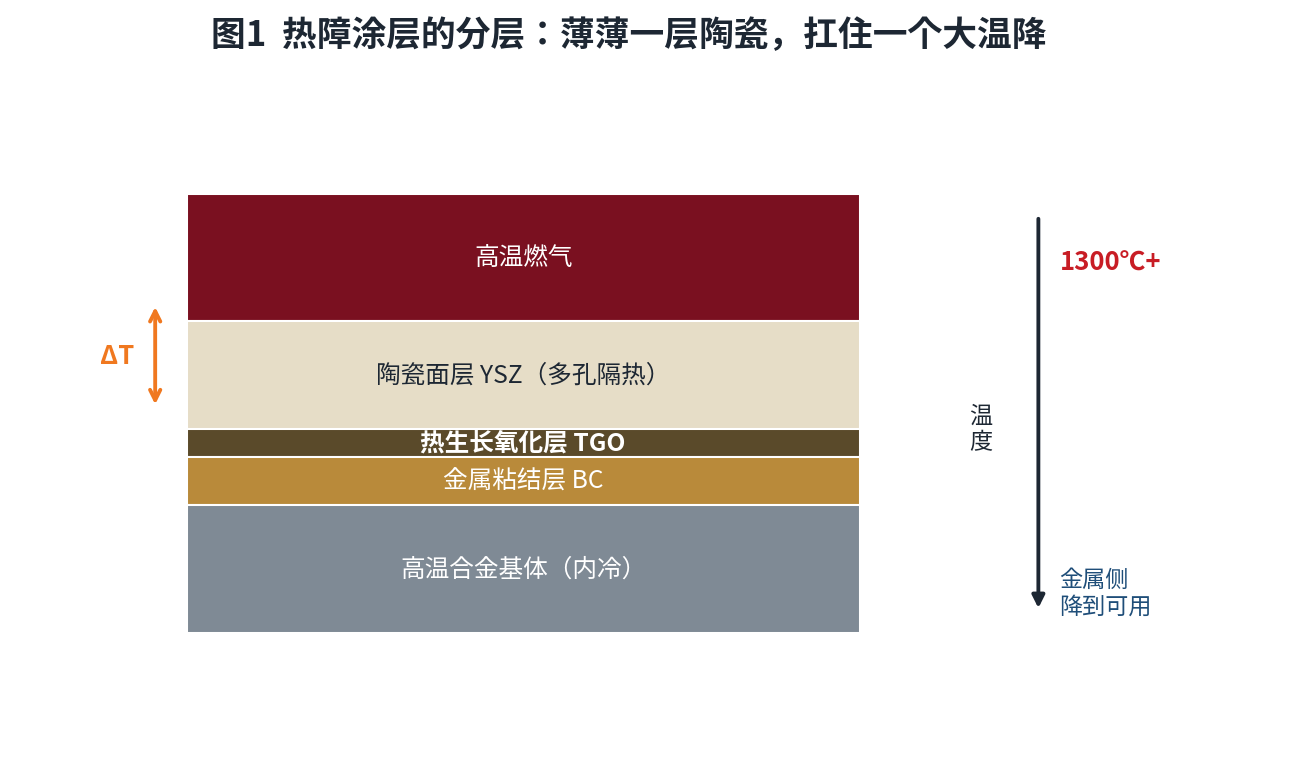
A complete thermal barrier coating is not a single material but a sophisticatedMulti-tier architecture, typically including from outside to inside:
- Ceramic Top Coat (TC)Outermost layer, typically 6~8 wt% Y₂O₃-stabilized ZrO₂ (YSZ), with a thickness of 100~400 μm. YSZ has extremely low thermal conductivity (1.0~1.5 W/(m·K)), making it the primary insulating material. It has a melting point as high as 2700°C and maintains a stable tetragonal phase structure from room temperature up to 1200°C.
- Thermally Grown Oxide (TGO)During high-temperature service, a thin layer of naturally formed α-Al₂O₃ develops on the bond coat surface as aluminum reacts with oxygen. This thermally grown oxide (TGO) starts at tens of nanometers thick and gradually grows to several micrometers. TGO is a double-edged sword: while a dense α-Al₂O₃ layer prevents further oxygen diffusion and protects the substrate, excessive thickness or the formation of non-protective oxides (such as spinels) can become sources of crack initiation.
- Bond Coat (BC): Located between the ceramic topcoat and the metallic substrate, typically consisting of MCrAlY (M = Ni, Co, or NiCo) alloys or platinum-modified aluminide coatings with a thickness of 50~150 μm. The bond coat serves two primary functions: providing an aluminum source to form a protective TGO and mitigating thermal expansion mismatch stresses between the ceramic topcoat and the metal substrate.
- Metal Substrate: Typically made of nickel-based single-crystal or directionally solidified superalloys, these components bear structural loads. Ultimately, all TBC design objectives aim to keep the substrate's actual operating temperature within safe limits.
③ Reality: Why TBC Allows the Engine to "Withstand Hundreds of Degrees More"
The value of TBC can be clearly illustrated with a set of numbers:
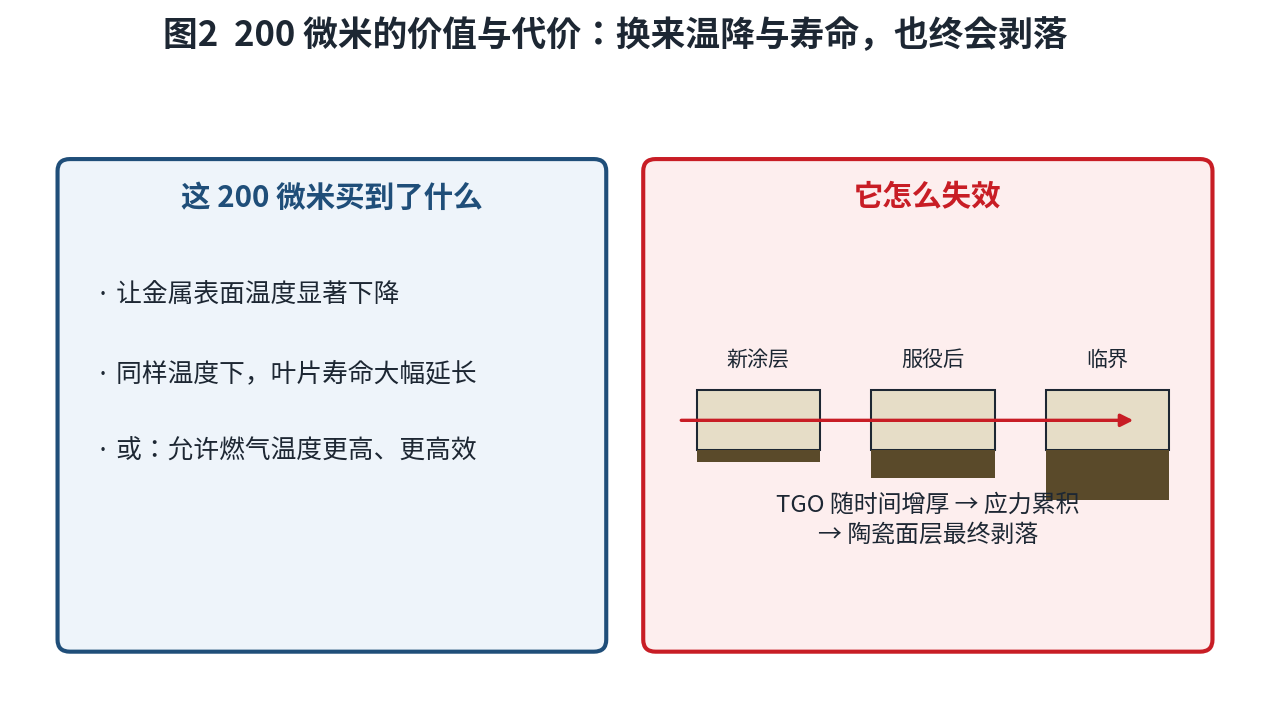
- Temperature drop: Typical YSZ TBCs reduce the surface temperature of the metal substrate.100~300℃This means that when the gas temperature is 1600°C, the metal surface may be only 1300°C or even lower.
- Double LifespanFor superalloys, reducing the operating temperature by 10~15°C approximately doubles creep life. The temperature reduction of 200°C provided by TBCs could theoretically extend blade life by several orders of magnitude.
- Boost EfficiencyFor every 100°C increase in turbine inlet temperature, engine thermal efficiency improves by approximately 3% to 5%. With TBC protection, engineers can safely push combustion temperatures higher to achieve better fuel economy and lower emissions.
- Cooling air savingsAfter TBC handles part of the insulation, the complexity and airflow demand for internal cooling channels in the blade are reduced. This allows more compressed air to be used for thrust generation, further boosting engine performance.
Without TBC, there would be no modern high-performance aero engines. It is one of the key enabling technologies that transformed engines from "usable" to "highly efficient."
④ Challenge: The Cost of 200 Microns
TBC may appear as a thin coating, but its failure is one of the most common failure modes in aero engines. What's causing it?
Thermal Expansion Mismatch — The Core Conflict
The coefficient of thermal expansion (CTE) for the ceramic topcoat (YSZ) is approximately 10×10⁻⁶/K, while that of the nickel-based superalloy substrate ranges from 14 to 16×10⁻⁶/K. Each heating and cooling cycle induces significant strain mismatch between the two layers. This repeated thermo-mechanical fatigue ultimately causes the ceramic layer to spall off the bond coat. The service life of a TBC is essentially a race against CTE mismatch.
Growth and Regression of TGO
In early service, the TGO is a protective α-Al₂O₃ layer. Over time, two issues arise: (1) continuous TGO thickening leads to interfacial cracking once internal stress reaches a critical value; and (2) depletion of aluminum in the bond coat triggers formation of non-protective mixed oxides (e.g., NiO, CoO, spinels). These oxides have larger volume expansion and inferior mechanical properties, accelerating coating failure.
CMAS Erosion: The Silent Killer of Next-Gen Engines
CMAS (CaO-MgO-Al₂O₃-SiO₂) is a glassy deposit formed when environmental contaminants such as dust, volcanic ash, and runway debris melt at high temperatures. When engines operate in desert or volcanic ash regions, or at airports with poor conditions, CMAS penetrates the pores and cracks of the YSZ ceramic layer. Upon cooling, it solidifies and reacts chemically with YSZ, causing the ceramic layer to become brittle, undergo phase transformation, and spall. As engine operating temperatures continue to rise, CMAS erosion has become the primary factor limiting TBC lifespan.
Process Sensitivity
TBC performance is highly sensitive to the manufacturing process. Atmospheric Plasma Spraying (APS) and Electron Beam Physical Vapor Deposition (EB-PVD) are the two dominant techniques. APS offers lower cost but yields less ideal columnar structures, whereas EB-PVD is more expensive yet produces superior strain-tolerant columnar grains. Minor fluctuations in process parameters—such as spray distance, power, and powder feed rate—can lead to significant performance variations. Maintaining consistency during mass production remains a major challenge for commercialization.
⑤ Tianyi Perspective: The Road from YSZ to Next-Gen TBCs Is Still Long
The YSZ thermal barrier coating (TBC) system, widely used in industry today, has been in service for over 40 years and is nearing its performance limits. Facing the higher turbine inlet temperatures (> 1800°C) and more severe environmental challenges of next-generation engines, YSZ is no longer sufficient:
- The maximum long-term operating temperature for YSZ is approximately 1200°C.Exceeding this temperature triggers a tetragonal-to-monoclinic phase transformation with approximately 4% volume expansion, causing coating cracking and spalling.
- YSZ has virtually no resistance to CMAS.: Molten CMAS can rapidly penetrate and degrade the microstructure of YSZ.
- The thermal conductivity of YSZ increases after prolonged exposure to high temperatures.Sintering densification gradually degrades thermal insulation performance.
The academic and industrial sectors are actively exploring next-generation TBC material systems, including:
- Rare-earth zirconates (RE₂Zr₂O₇): Pyrochlore-structured materials such as La₂Zr₂O₇ and Gd₂Zr₂O₇ exhibit thermal conductivities 30%~50% lower than YSZ and offer superior chemical inertness against CMAS. Their primary drawback is low fracture toughness, requiring use in bilayer or multilayer structures with YSZ.
- Rare earth tantalates (RETaO₄)The iron-doped toughening mechanism endows it with excellent strain tolerance, while also providing low thermal conductivity and good CMAS resistance.
- high-entropy ceramicsLeveraging the "cocktail effect" of multi-principal element solid solutions to simultaneously achieve low thermal conductivity, high coefficient of thermal expansion, and high phase stability has become a key research focus in recent years.
Tianyi Quan'an's exploration in precursor-based ceramic (PHEC) coatings aligns closely with the future direction of next-generation thermal barrier coatings (TBCs). PHEC coatings, fabricated via polymer-to-ceramic conversion, enable high-purity, composition-tunable ceramic layers at lower temperatures, offering a more flexible and cost-effective pathway for developing advanced TBC systems. We believe the future of TBCs lies not only in discovering "better ceramics" but also inBuild a complete technical system spanning material design, process optimization, and life prediction.Unleash the full potential of 200 microns.
⑥ Further Reading · Test Consultation
In-site Extensions:
- → Material Map: Comprehensive Overview of Thermal Protection Materials
- → Ceramic Matrix Composites (CMC)The Temperature Ceiling of Aircraft Engines
- → Ablative materialsA classical survival strategy: sacrifice yourself.
- → Three Hot PathsConduction, Convection, Radiation: The Three Lines of Defense Against Heat
Consultation Test
Not sure if your application suits a TBC solution, or want to learn about the latest advances in next-generation TBC materials? Contact Tianyi Extreme Environment Laboratory for a thermal environment assessment and recommendations on matching coating materials and system designs.