
Hypersonic Vehicles: Withstanding High Temperatures Over Extended Periods Is the Real Challenge
When hypersonics comes to mind, many people immediately think of "speed." But for materials engineers, the real nightmare isn't a brief spike in temperature—it's prolonged, continuous heating. A high peak is challenging; sustained high heat flux over time is the true challenge.
Common sense: Cruise heat is "earned" through endurance.
When hypersonics comes to mind, many people immediately think of "speed." But for materials engineers, the real nightmare isn't a brief spike in temperature—it's prolonged, continuous heating. A high peak is challenging; sustained high heat flux over time is the true challenge.
Figure 1 Short Burst vs. Continuous: Cruise heat is "built up" through endurance, accumulating inward over time.
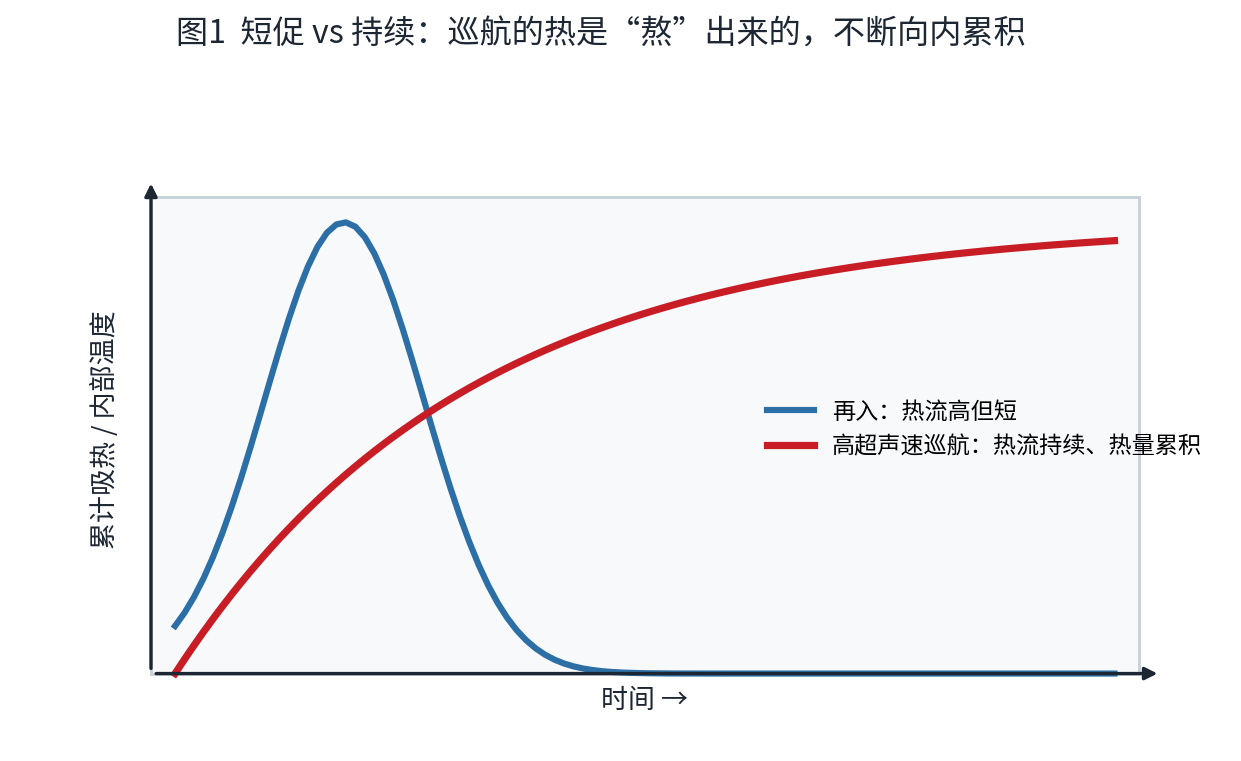
Figure 1 Short vs. Sustained: Cruise heat continuously builds up internally
Re-entry is a short burst: heat flux peaks high but lasts only minutes; materials often survive using their own thermal mass and ablation. Hypersonic cruise, by contrast, is "continuous": peak heat flux may be lower, but it persists for a long time, causing heat to accumulate deep within the material. This demands sustained high-temperature resistance and a complete thermal protection system.
Reality: It's not just about peak performance—it's about sustained time.
Why is "long duration" Figure 2 harder? Heat accumulates over time.
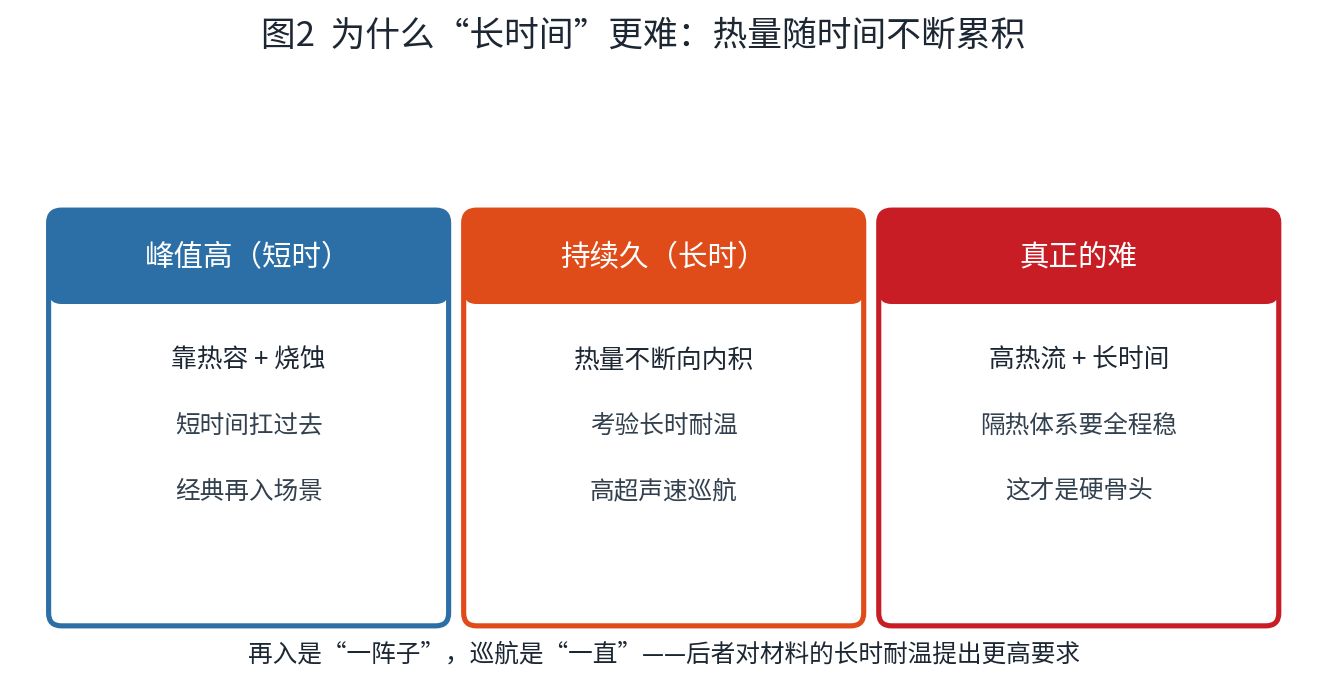
Why is Figure 2 "long-duration" more challenging: high peak and sustained high heat flux are two distinct difficulties.
Evaluating hypersonic thermal protection requires two dimensions: peak heat flux magnitude and duration. Short-duration peaks can be managed with temporary resilience, but sustained high heat flux demands materials that remain stable throughout the entire flight—maintaining temperature resistance, oxidation resistance, thermal insulation, and performance without degradation. Any compromise is unacceptable.
Challenges: Long-term stability and resistance to degradation
Prolonged exposure to high temperatures exacerbates all chronic issues: material oxidation, phase transformation, insulation structure collapse, coating degradation... These may not appear in short-term tests but will gradually manifest under sustained operating conditions. Ensuring materials remain durable and stable over time is the most challenging aspect of hypersonic thermal protection systems.
Tianyi Perspective: Evaluate based on the "heat flux–time" history
We evaluate a solution not by how high a temperature it withstands instantaneously in a lab, but by its ability to remain stable under realistic "heat flux–time" profiles. Tianyi Quan'an's capabilities, including arc wind tunnels, are designed to replicate specific heat flux levels and durations, ensuring materials are rigorously tested under representative long-duration operating conditions.
For hypersonics, the ability to endure is often more critical than the ability to withstand high loads.
Read More · Test Consultation
In-site Extensions:
- Aerodynamic Heating Basics: Why Doubling Speed Increases Heat Flux by Eight Times
- → High-entropy ceramics: Why mixing five elements creates greater stability
- → Arc Jet Wind Tunnel: Recreating Atmospheric Reentry on Earth
Consultation TestNeed to verify material stability under prolonged high heat flux? Contact Tianyi Extreme Environment Laboratory.