
high-entropy ceramics
Why does blending five elements make things more stable?
② Fundamentals: What Are High-Entropy Ceramics? Five Elements on Equal Footing
Traditional ceramics typically feature one or two elements as their core components—for instance, zirconia (ZrO₂) is centered on zirconium, while silicon carbide (SiC) is built around silicon and carbon. However,High-Entropy Ceramics (HEC)Breaks with this convention: it includes bothFive or more principal elements, and the atomic ratio of each element is close to equimolar (typically between 5% and 35%), with no single element dominating.
This sounds like throwing a bunch of things together at random, but it's actually the opposite. When enough elements are mixed in near-equal proportions, the systemconfigurational entropywill rise sharply. According to the thermodynamic equation ΔG = ΔH - TΔS, when entropy (ΔS) is sufficiently large, the Gibbs free energy (ΔG) can remain negative even if the enthalpy of mixing (ΔH) is positive—meaning that high-entropy alloys are more stable at elevated temperatures than any single-phase compound.More stableThis is the origin of "high entropy": not chaos, but order arising from chaos.
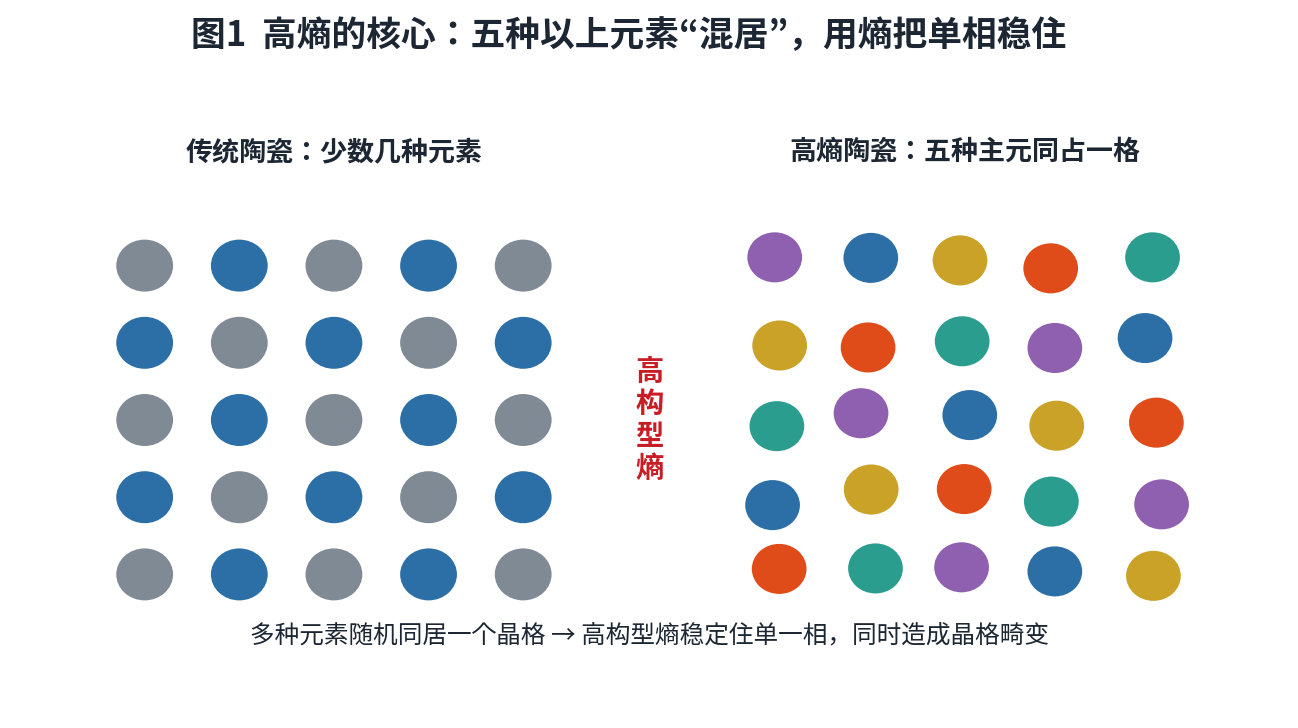
High-Entropy Ceramics vs. Traditional Ceramics: From "One Dominant Player" to "Five-Family Republic"
- Traditional ceramics: Dominated by one or two elements, performance is constrained by the inherent properties of those elements. Optimization potential is limited, often resulting in trade-offs—enhancing heat resistance compromises toughness, while reducing thermal conductivity sacrifices strength.
- high-entropy ceramics: Multiple elements collectively form the lattice, each contributing distinct electronic structures and bonding characteristics. By adjusting the elemental composition and ratios, it is possible to tune a single material systemSimultaneously optimize multiple performance metricsBreak through the ceiling of traditional ceramics' "single-variable optimization."
3. Reality: The Four Core Effects — Why "Mixing" Works Better
High-entropy ceramics have emerged as one of the hottest directions in materials science in recent years because they exhibit four unique effects, each opening new possibilities for extreme-environment applications:
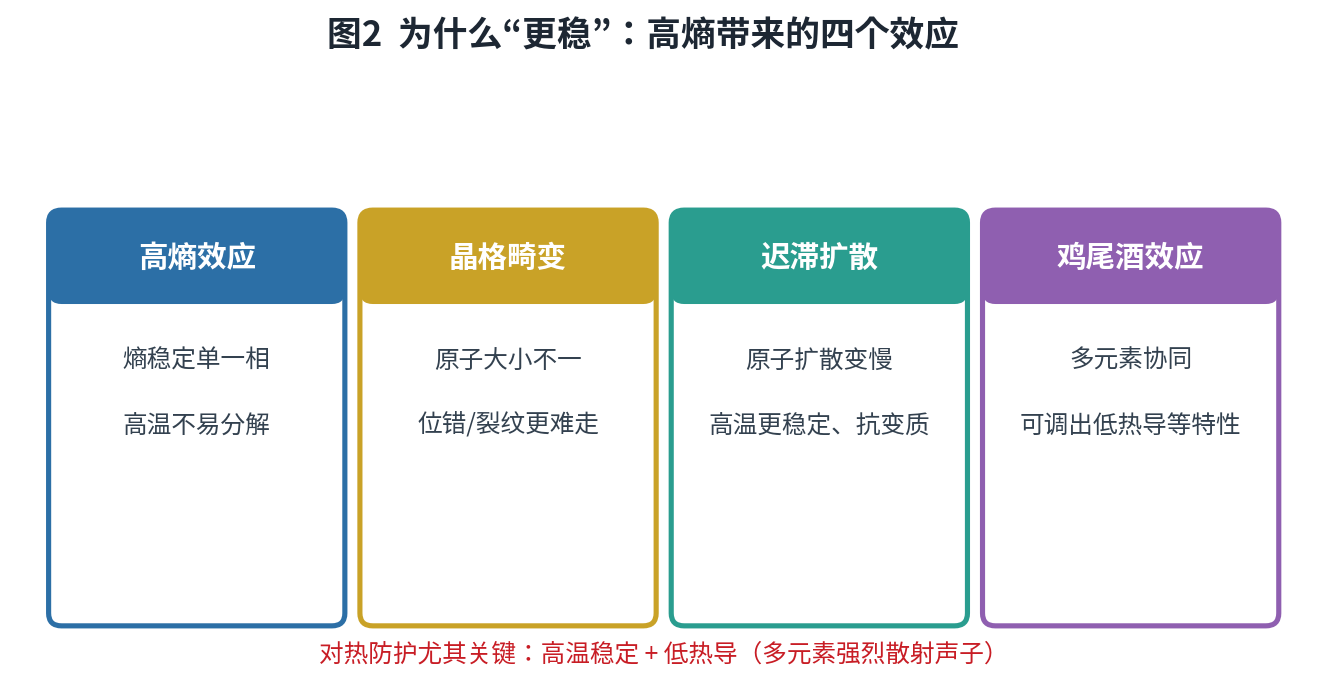
Effect 1: High-Entropy Effect
As previously mentioned, the high configurational entropy arising from multi-principal element mixing makes the solid solution phase thermodynamically more stable. This implies that high-entropy ceramics exhibitUnlikely to undergo phase separation or precipitate a secondary phase, maintaining a single-phase structure up to extremely high temperatures. For thermal protection materials required to operate long-term above 1500°C, this high-temperature phase stability is essential.
Effect 2: Lattice Distortion Effect
Five or more different-sized atoms crowded into the same crystal lattice inevitably lead to severelocal lattice distortionThis distortion is not a defect but a feature: it strongly scatters phonons (the carriers of heat), significantly reducing thermal conductivity. Experiments show that the thermal conductivity of many high-entropy oxides is only a fraction of that of their single-component oxide counterparts with the same structure.1/3~1/5, even lower than YSZ (the current mainstream thermal barrier coating material). This is significant for insulation and thermal barrier coating applications.
Effect 3: Sluggish Diffusion Effect
In multi-principal element environments, each atom is surrounded by dissimilar neighbors, requiring the overcoming of distinct energy barriers during diffusion. This results in significantly lower atomic diffusion rates in high-entropy ceramics compared to traditional ceramics, as evidenced by:Slow grain growth, extremely low phase transformation rate, and excellent creep resistance at high temperatures.In other words, high-entropy ceramics are not only "heat-resistant" but also "time-tested"—they exhibit minimal performance degradation after prolonged exposure to high temperatures.
Effect 4: Cocktail Effect
This is one of the most fascinating properties of high-entropy materials: the synergistic effect of multiple elements can produceBeyond the simple sum of its componentscomprehensive performance. For instance, a certain high-entropy boride may simultaneously exhibit ultra-high melting points (from Hf, Ta), excellent oxidation resistance (from Cr, Al), and good mechanical toughness (from Ti, Zr)—properties that are often mutually contradictory in traditional single-component borides. This "1+1+1+1+1 > 5" effect is the core value of high-entropy design.
④ Challenges: Promising prospects, yet hurdles remain
The concept of high-entropy ceramics is exciting, but several key challenges remain to be overcome before moving from the lab to engineering applications:
- Huge design space for ingredientsWith five or more elements, the number of possible combinations is virtually infinite, making trial-and-error screening extremely inefficient. Developing high-throughput compositional screening methods—such as machine learning-assisted design, CALPHAD calculations, and high-throughput experimentation—is a core bottleneck in current research.
- Manufacturing process not yet matureHigh-entropy ceramics typically require extremely high synthesis temperatures (> 1800°C) to achieve full solid solution. Significant differences in reaction kinetics among oxide, carbide, and boride precursors often lead to compositional segregation or unreacted residues. Emerging techniques such as Spark Plasma Sintering (SPS) and Flash Sintering are being explored but remain distant from mass production readiness.
- Insufficient performance data accumulatedAs an emerging field with only a decade of history, high-entropy ceramics lack a comprehensive performance database. Critical engineering data—such as coefficient of thermal expansion, elastic modulus, fracture toughness, high-temperature creep, and oxidation kinetics—remain unavailable for most high-entropy ceramic systems.
- Compatibility with existing systemsHigh-entropy ceramics will ultimately be integrated into existing thermal protection systems as coatings, fibers, or bulk components. Their compatibility with CMC matrix thermal expansion, chemical compatibility with bond coats, and long-term stability in gas environments require systematic validation.
- Cost and RepeatabilityFormulating high-purity raw materials requires extreme precision; even minor deviations can significantly alter phase composition and performance. Balancing cost control with batch consistency is essential to transition from "lab-grade" materials to "engineered" solutions.
5. Tianyi's Perspective: High-Entropy Design Opens New Dimensions for Precursor Ceramics
Tianyi Quan'an regards high-entropy ceramics asKey candidate direction for next-generation thermal protection materials, particularly its potential for integration with the precursor ceramic (PDC/PHEC) technology pathway.
Conventional control of the composition of PDC ceramics relies on precursor molecular design and filler addition, with available element combinations limited by the synthetic feasibility of organic precursors. In contrast, high-entropy design offers a novel approach for PDC:In-situ formation of high-entropy ceramic phases during polymer conversion by incorporating multiple metal-organic precursors or nanofillersThis approach preserves PDC's machinability and low-temperature forming advantages while leveraging the low thermal conductivity, high phase stability, and superior overall performance of high-entropy ceramics.
Specifically, Tianyi Quan'an is exploring the following areas:
- High-entropy oxide coatingsLeverage synergistic effects of multiple rare earth and transition metal elements to achieve lower thermal conductivity than YSZ and higher CMAS resistance, positioning this material as a candidate for next-generation thermal barrier coatings.
- High-entropy carbides/borides: Leverage the synergistic protection of ultra-high melting points and antioxidant elements to develop non-ablative materials capable of short-term operation in oxidizing environments above 2000°C.
- High-entropy PDC composite coatingIntroducing high-entropy nanophases into the precursor-derived ceramic matrix to simultaneously enhance coating temperature resistance, toughness, and environmental durability via the cocktail effect.
We believe the value of high-entropy ceramics lies not in replacing all traditional ceramics, but inA new approach for extreme operating conditions that traditional materials cannot handleWhen five elements blend together to achieve greater stability, what we see is not chaos, but the limitless possibilities of material design.
⑥ Further Reading · Test Consultation
In-site Extensions:
- → Material Map: Comprehensive Overview of Thermal Protection Materials
- → Thermal Barrier Coating (TBC)The Value of 200 Microns on the Blade
- → Polymer-Derived Ceramics (PDC)The Chemical Magic: From "Polymers" to "Ceramics"
- → Ceramic Matrix Composites (CMC)The Temperature Ceiling of Aircraft Engines
Consultation Test
Interested in high-entropy ceramics for thermal protection? Contact Tianyi Extreme Environment Laboratory to learn about our latest research and collaboration opportunities at the intersection of high-entropy materials and precursor ceramics.