
Sintering a ceramic in seconds: How Ultrafast High-Temperature Sintering (UHS) is reshaping advanced ceramics manufacturing
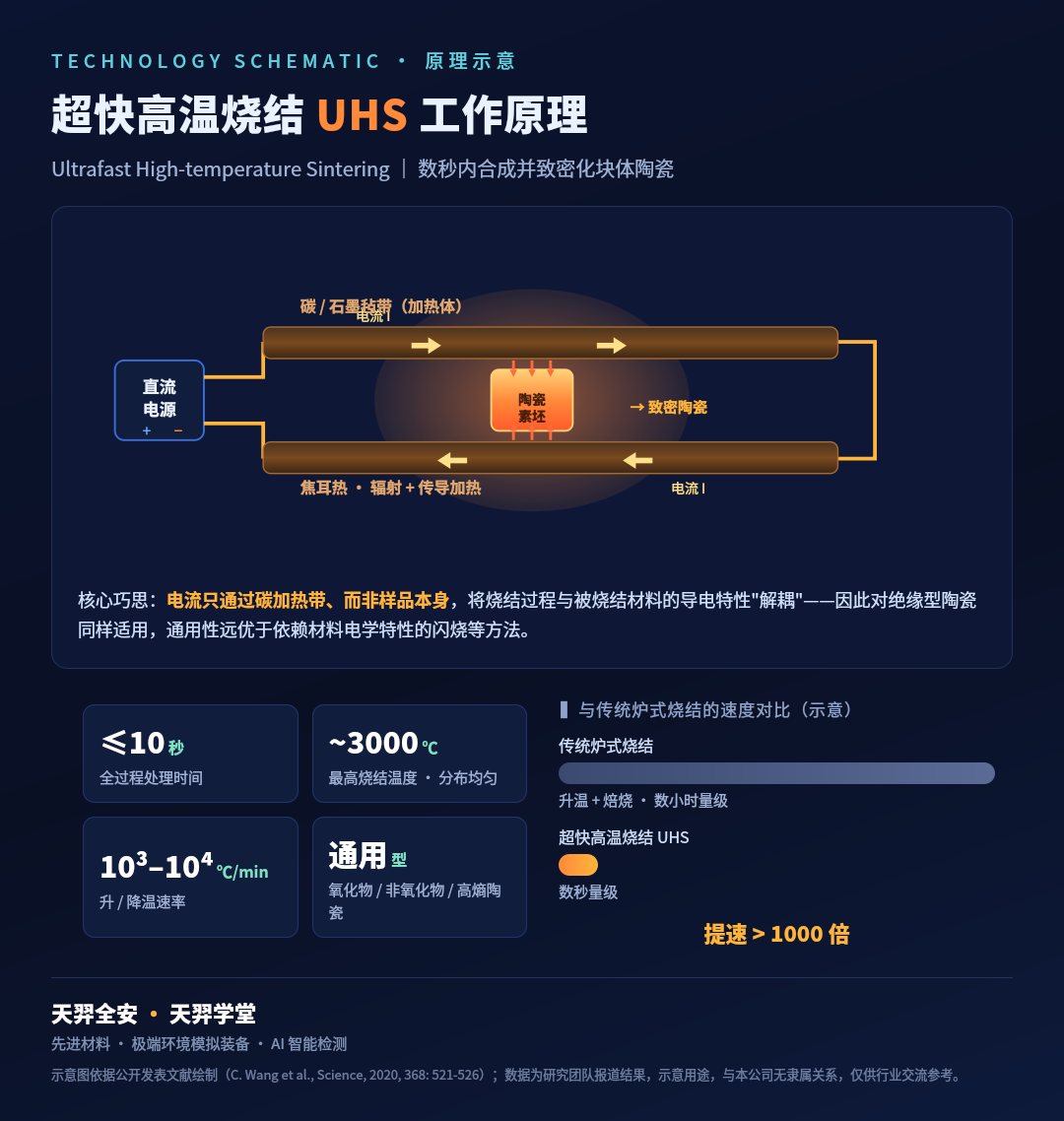
Science Cover Tech Deep Dive: The University of Maryland's Hu Liangbing team developed Ultrafast High-Temperature Sintering (UHS), slashing ceramic sintering time from hours to seconds. With heating rates of 10³-10⁴°C/min and peak temperatures up to 3000°C, this breakthrough is revolutionizing advanced ceramics manufacturing.
A "seconds-long" technology featured on the cover of Science
Traditionally, ceramic sintering has been seen as a "slow and meticulous" process—heating the furnace takes hours, and the material's firing requires several more, with a full cycle often lasting over ten hours. On 2020 5, 1, a research paper titled "A General Method for Synthesizing and Sintering Bulk Ceramics in Seconds" appeared on the cover of *Science* (Vol. 368, Issue 6490, DOI: 10.1126/science.aaz7681). Led by Professor Liangbing Hu's team at the University of Maryland, with Dr. Chengwei Wang as the first author, and involving collaboration from Virginia Tech, UC, and other institutions, this study introduced a groundbreaking new process later widely known as Ultrafast High-temperature Sintering (UHS).
Principle: The sample is "sandwiched" between two carbon heating strips.
The ingenuity of UHS lies in its heating method. The research team sandwiched a pressed ceramic green body between two carbon/graphite felt strips and passed current through the carbon strips to rapidly heat the sample via Joule heating, using both thermal radiation and conduction. A key advantage of this design is that the current flows through the carbon heater rather than the sample itself, decoupling the process from the electrical properties of the material being sintered. This makes UHS applicable even to insulating ceramics, significantly broadening its versatility. This fundamental distinction sets it apart from methods like flash sintering, which rely on the material's electrical characteristics.
Three sets of data. Understanding its "extreme."
According to publicly reported experimental results from the research team:
- Ramp rate: Approximately 10³ to 10⁴°C/min, representing an exceptionally high magnitude in the materials manufacturing sector;
- Sintering temperature: reaches up to approximately 3000°C with even heat distribution;
- Processing Time: The entire process completes in approximately 10 seconds—over 1,000 times faster than traditional furnace sintering.
Rapid heating not only saves time but also transforms the sintering process: it suppresses excessive grain growth, minimizes loss of volatile elements, and enables densification under "far-from-equilibrium" conditions. This creates opportunities to achieve microstructures and properties that are difficult or impossible to obtain with conventional slow heating.
Why is the industry so closely watching?
For advanced ceramics, especially thermal protection and extreme environment materials, UHS has multiple implications:
First, expand the scope of materials.Multi-component, difficult-to-sinter systems such as non-oxide ceramics and high-entropy ceramics are often challenging to fabricate due to complex compositions and susceptibility to decomposition. Ultrafast, high-temperature, non-equilibrium processing routes offer new tools for synthesizing these advanced materials. In recent years, UHS has been extended to diverse systems including silicon nitride, alumina, transparent ceramics, solid-state electrolytes, and even glasses. Research is now advancing toward large-scale components with complex geometries, establishing a vibrant field of study.
Second, empower high-throughput and intelligent R&D.Single experiments compressed from hours to seconds enable rapid screening of thousands of ingredient formulations. This capability aligns perfectly with AI-driven materials discovery—rapid trial-and-error, characterization, and iteration form the foundation of data-driven new material development. Related technologies are already advancing toward commercialization through university-incubated startups.
Conclusion
From "hours" to "seconds," UHS represents not just efficiency gains but a paradigm shift in advanced ceramics—from "trial-and-error based on experience" to "high-throughput, AI-driven R&D." Tianyi Quan'an focuses on rare-earth high-entropy silane precursor ceramic (PHEC) thermal protection materials, building an ecosystem around "advanced materials, extreme environment simulation equipment, and AI-powered inspection." We continuously monitor global advancements in material manufacturing and characterization. Grasping these underlying technological trends is the foundation of our commitment to serving aerospace and other high-end equipment sectors while deepening expertise in extreme environment materials.
This article provides industry-related educational information. All technical data and findings cited are drawn from the aforementioned publicly published literature and reports (C. Wang et al., Science, 2020, 368: 521-526). The related research was conducted by third-party research institutions and is not affiliated with our company. This content is intended for industry exchange and reference purposes only.
Technical Cooperation Inquiry
Interested in the content or want to learn more? Contact us.
Get Started